Automated Follow-Up Workflows for High-Volume Field Sales Teams
Conversation-aware triggers automate follow-up when field reps capture deal context immediately.
Field sales teams don't lose deals at the follow-up stage because reps don't care about closing business; the reasons are structural. Between every call, a rep at the inside sales desk has a laptop, a CRM tab open, and a phone within reach. Conversation data lives in the rep's head until it gets written down, and it frequently gets written down only after the rep is home that evening, or never. That delay alone starts a chain of three compounding failure modes that scale with visit volume.
The first is data loss. The second is timing collapse: follow-up that should go out within hours of a visit, while the conversation is still fresh for the prospect, instead goes out the next morning, two days later, or never, because the rep was already at the next stop when the window mattered. The third is sequence drift. Reminders will not fix this, and a bigger CRM will not fix it either, because the problem is not storage or motivation. The workflow asks a human being standing in a parking lot to do clerical work that belongs to a system, and the only durable fix is redesigning where and how that work gets done.
What conversation-aware automation means for field teams
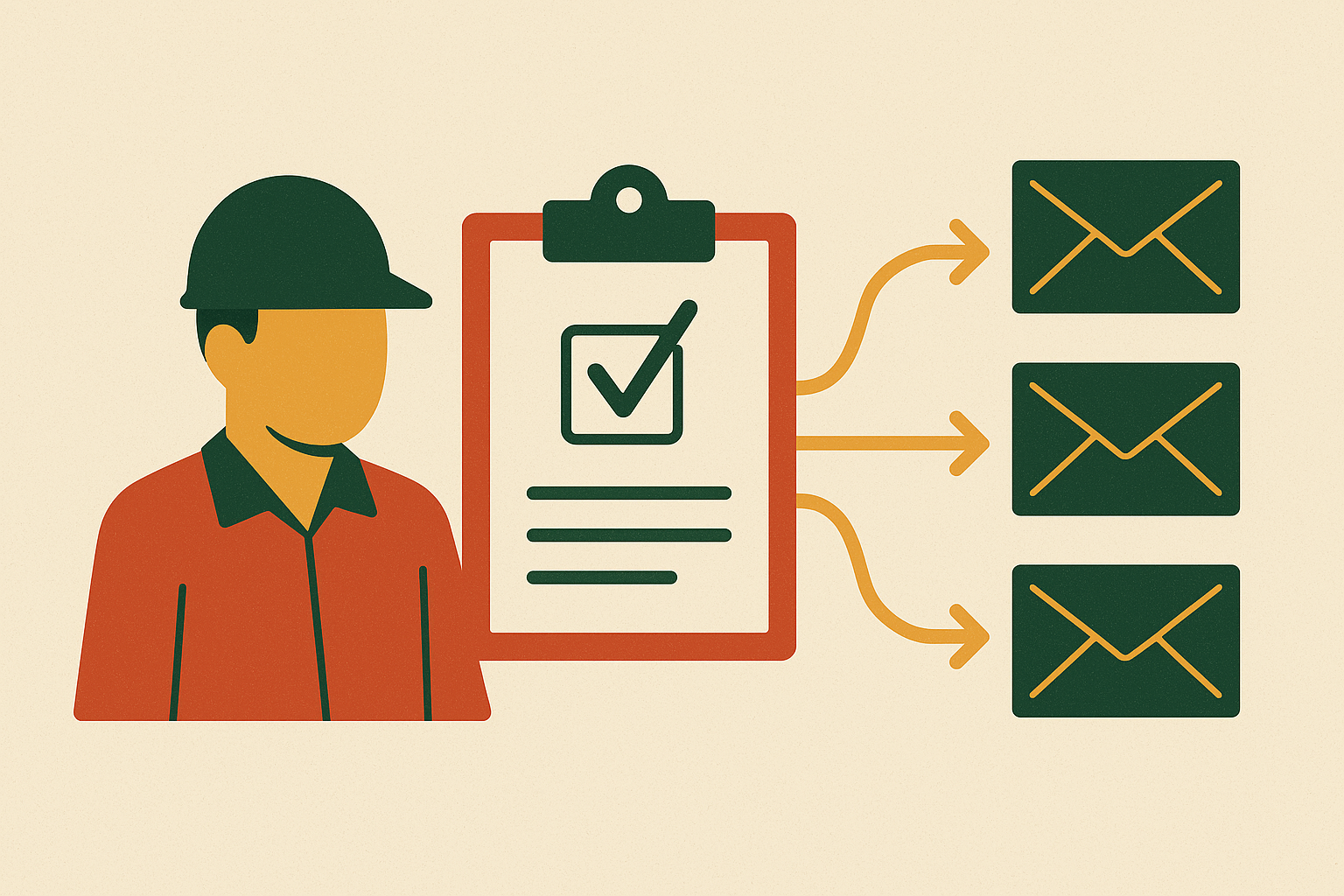
Effective follow-up automation in the field depends on what triggers it, not on how many steps it eventually executes. Every functional automation, regardless of industry or tool, runs on the same three components: a trigger that fires when a specific event occurs, a condition that filters whether the trigger should actually result in action, and an action, which is the task, message, or CRM update that executes without a human touching it. The quality of a field automation system rests entirely on what counts as the trigger.
Two architectures compete for that role. A rule-based cadence sends a follow-up email 48 hours after a meeting regardless of what happened in that meeting, which is adequate for low-stakes, high-volume inside sales motions but breaks down fast in the field, where one visit might end in a signed order and the next might end in a flat rejection. Conversation-aware automation solves that problem, but only on one condition: the conversation data has to be captured and structured before any trigger can read it. That requirement is the foundation the system is built on, not a footnote to it. A sales leader can't just shop for an automation platform and expect conversation-aware triggers to show up. The build has to start with how conversation data gets captured and structured during or right after the visit, because every automated action downstream depends on that capture working.
The capture layer: turning what happens in the field into automation fuel
Automation that fires on real conversation signals requires a capture mechanism built for field conditions, not one that assumes a desk and a keyboard. Five data points need to be captured during or immediately after a visit for any downstream trigger to work: what the prospect expressed interest in, what objections came up, what the rep committed to sending or doing next, what the agreed next step is and when it happens, and where the deal stands after that conversation.
Three mechanisms handle this capture in practice. A rep can also use photo and business card capture to enrich a contact record on the spot, avoiding typing it in later. Field sales automation research reports that organizations using these capture methods log six times more CRM data than those relying on manual entry, and that multiplier comes entirely from removing the recall step, the moment where a rep has to reconstruct a conversation from memory hours after it happened.
None of this works as a one-way street. Two-way CRM sync is a requirement rather than a convenience: field activity logged on a rep's phone has to appear in the CRM automatically, and any change made in the CRM has to flow back to the rep's mobile view without forcing a second round of data entry. Skipping this layer pushes the consequences downstream. Workflow sequencing research establishes that automation built on incomplete or inconsistently filled CRM fields fires to the wrong people in the wrong order. The automation then amplifies the data problem that was already there.
Which follow-up tasks to automate first
The sequence in which a field team automates its follow-up tasks matters as much as the automation itself, because building sequences on top of a dirty data layer is the most common way these systems collapse under their own weight. The first task to automate is lead response and initial assignment, and it carries the highest leverage of any step because speed to lead affects close rates directly and does not depend on any other part of the system being clean first. When a new inbound field lead arrives, it should trigger rep assignment, an acknowledgment message to the prospect, and a follow-up task, all within minutes. Workflow automation research treats this as the single highest-leverage first move available to a sales organization: companies that automate lead response have cut response times from roughly 13 hours down to about 3.5 hours using lead-routing tools alone, and AI-powered automation has pushed that further still, down to sub-five-minute response in some deployments.
The second task is activity logging and CRM sync, and it needs to be automated before any sequence gets built on top of it, because clean data is the prerequisite every later step depends on. Once deal context exists to inform them, AI-powered platforms can coordinate these multi-channel touchpoints and personalize them at scale, as sales follow-up automation research describes.
The fourth task is pipeline stage progression, which should automate on real deal events, a proposal sent from the field, a demo completed, a quote accepted, rather than waiting on a rep to update a stage manually days after the fact; this triggers close date updates, manager notifications, contract templates, and next-step tasks without manual intervention. The fifth and final task to automate is reporting and forecast updates, and it comes last by design, because automated dashboards built on dirty pipeline data produce numbers that look precise but are wrong. Reporting only becomes trustworthy once every layer beneath it, lead response, activity logging, sequencing, and stage progression, is already running accurately and automatically.
How to design trigger-based sequences around real field scenarios
Once the data layer behind a field sales operation is clean, you get the highest value from building sequences around the scenarios that generate most of the follow-up volume. Four scenarios cover most of that volume, and each one maps cleanly onto the trigger, condition, action structure set out earlier.
Post-visit follow-up is the most frequent scenario a field team will encounter. Quote follow-up works on a similar structure: the trigger is a proposal or quote sent from the field, the condition checks for a lack of response after a defined window, and the action sends an automated check-in message, escalating to a rep phone-call task if a second touch also goes unanswered.
It handles cases when a scheduled appointment falls through or a rep logs a no-contact visit. Stalled deal re-engagement covers deals stuck in a stage beyond a defined number of days without activity; where the deal value sits above a threshold or carries a strategic account flag, the action alerts the manager, assigns the rep a task, and sends an automated check-in to the prospect built around a new value angle.
Rule-based cadences and AI-adjusted cadences diverge sharply inside these same scenarios. A rule-based system sends the next message 48 hours later no matter what the prospect has done in between. Sales follow-up automation research describes AI platforms surfacing these intelligent next actions and coordinating touchpoints across channels, but only if deal context, the conversation signal captured earlier in the workflow, is available to inform the decision. One further risk belongs inside this design work: single-threaded deals, where a field rep's only contact at an account leaves or goes dark, are a common point of failure, and building stakeholder mapping and contact verification into the post-visit sequence reduces exposure to it.
How real-time coaching during visits improves automation
The most reliable trigger for follow-up automation is a well-structured conversation where commitments, objections, and next steps surface clearly while the rep is still standing in front of the prospect, an outcome that happens more consistently when coaching reaches the rep in the moment rather than in a debrief days later, and coaching delivered after the fact can only diagnose what went wrong in a visit that has already ended. Coaching delivered during the visit changes the outcome of that visit directly: the rep confirms a commitment before leaving, names the right next step out loud, or addresses an objection on the spot.
That distinction matters for automation specifically because the structured data point, a confirmed follow-up date, a named stakeholder, a clearly stated objection, enters the conversation record automatically once it has been said clearly, and a clearly captured data point becomes a precise trigger for the sequences described earlier. The effect compounds over time. Teams coached in real time produce more consistently structured conversations, which gives automation more reliable triggers to fire on, which improves the timing and personalization of every follow-up that goes out, which in turn moves close rates. The flywheel runs in one direction: from coaching, through capture, into automation.
Tools that handle field-specific follow-up automation in 2026
No single platform covers every layer of this stack, so you need to know which layer each tool actually serves. Sales engagement and multi-channel sequencing make up one category. ZoomInfo combines B2B contact data, buyer intent signals, conversation intelligence through Chorus, and AI-driven sales engagement inside one GTM platform; intent signals trigger automated follow-up when a prospect starts researching relevant topics, native CRM sync logs activity without manual entry, and GTM AI connects ZoomInfo's data to external AI agents through MCP or API. HubSpot Sales Hub offers CRM-native follow-up automation, with sequences enrolling automatically through workflow triggers, but CRM property and list-membership triggers need an Enterprise plan, while Professional accounts are limited to form submission and page view triggers. HubSpot suits teams that want CRM-native automation without standing up a separate RevOps function to run it.
Field route optimization and visit-triggered workflows form a second category, built around the physical reality of a territory. Leadbeam is purpose-built for field reps, with voice and photo capture that updates CRM records instantly and assigns follow-up tasks, real-time route optimization, and the ability to consolidate CRM data, including Salesforce, while generating pre-visit battlecards. Salesforce Maps suits teams already embedded in Salesforce that need territory coverage and route automation built into that existing environment.
CRM platforms with automation engines form the last category, and the practical question here is not whether pipeline stage automation exists, because it is available across most major platforms including HubSpot, Pipedrive, and Salesforce. What matters is whether stage transitions fire on real field actions, a signed order, a completed demo, a sent proposal, or depend on a rep remembering to update a stage manually at the end of a long day.
How to measure whether the workflow is working
A follow-up automation system that produces plenty of activity, emails sent, tasks created, sequences enrolled, without moving outcomes is either automating the wrong tasks or firing on the wrong triggers, and the right set of metrics will show which. Capture quality metrics come first: CRM field completion rate per rep per visit establishes the baseline for whether triggers have reliable data to act on at all, and the time between visit completion and CRM update reveals how much manual logging lag still exists in the system, a lag that automated capture should collapse close to zero.
Follow-up execution metrics come next. The time from visit to first follow-up touchpoint is the most direct read on whether automation is actually eliminating the delay that caused the original problem. Sequence completion rate shows what share of started sequences reach their end without a manual intervention breaking the chain partway through, and response rate by sequence type shows which scenario-based sequences, post-visit, quote, no-show, are generating real engagement and which are not.
Outcome metrics close the loop. Deal velocity, the time from first visit to close, should be tracked before and after automation deployment to see whether the system is actually shortening sales cycles. Close rate by follow-up speed tier tests whether faster automated follow-up correlates with higher close rates in a team's own data, and stage stall rate, the share of deals stuck beyond a defined threshold, should drop as pipeline stage automation fires re-engagement actions on its own.
When these numbers disappoint, you run the diagnosis backward through the stack. Salesforce's productivity research notes that sales leaders rely on these tools to monitor performance, identify coaching opportunities, and forecast with accuracy, so measurement becomes the mechanism that connects automation investment to actual revenue instead of an afterthought bolted on once the system is live. Coaching data and automation data belong in the same weekly review, because the same signal, which reps generate clean capture data, which sequences convert, and where the workflow breaks, points to both a coaching opportunity and an automation fix at once. A team that reviews these numbers every week is positioned to compound these gains.