Evaluating AI Sales Coaching Tools Built for Field Teams
Field teams need tools designed for doorsteps, not desks.
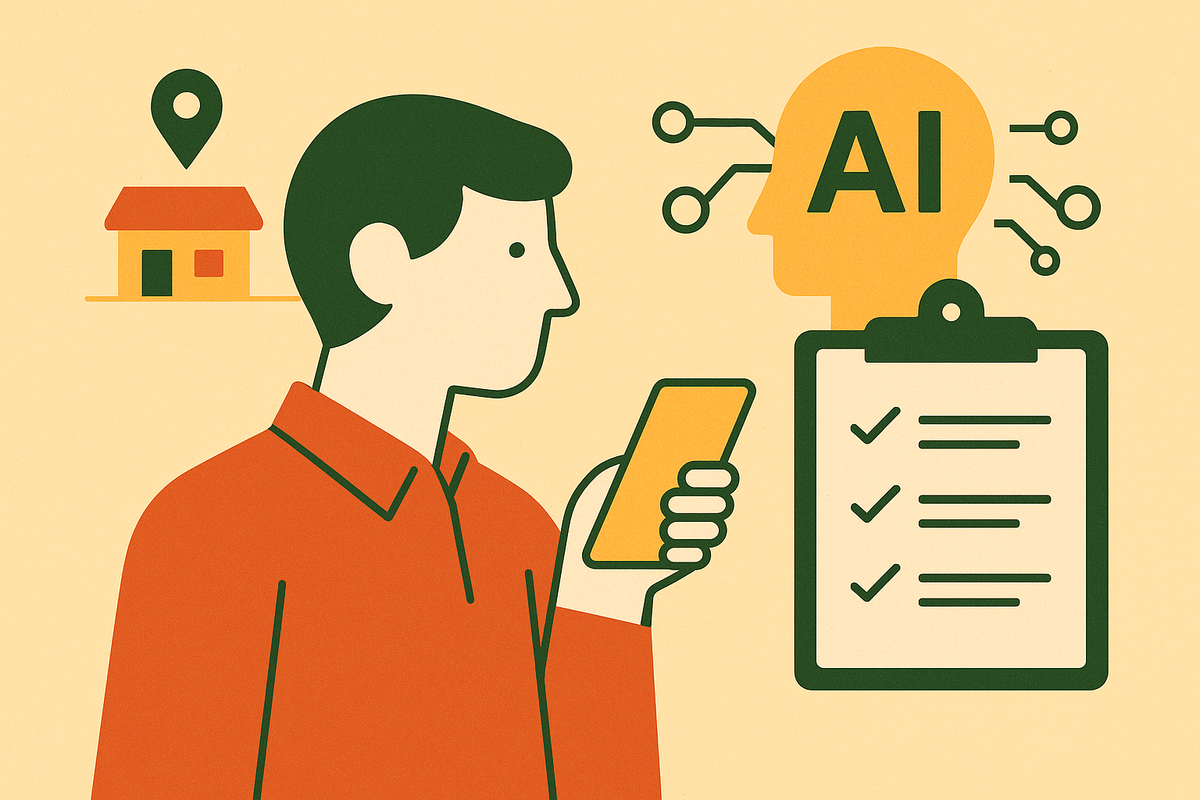
A field rep's workday happens on doorsteps, in trucks idling between appointments, and in parking lots where the only available desk is the driver's seat. Most AI sales coaching tools were not built with that environment in mind. The dominant category grew up around a desk-based, phone-and-video paradigm: stable Wi-Fi, dual monitors, and enterprise call-recording software running quietly in the background while an inside rep works a headset through back-to-back Zoom calls. A field rep works through dead zones. They pitch across kitchen tables and job sites, and they log notes between visits, not during them. None of the major platforms in this category were designed around those conditions, and that gap reduces adoption numbers. SPOTIO's State of Field Sales survey found that one in three field sales teams has not adopted a single AI tool, but this shortfall is specific to outside reps, not a sign that field sales lags the broader market on AI.
Where field teams have adopted AI, the adoption clusters at the simplest entry points: email personalization, basic call recording. The higher-value capabilities, like behavior scoring, real-time coaching, and forecasting, stay largely untouched. The reason is mechanical. Conversation intelligence tools built to record audio from a Zoom or Teams session have no way to capture what happens at a kitchen table, on a job site, or on a showroom floor unless the tool was explicitly built to record in-person conversation through a phone. A platform that listens through a web conferencing API simply has nothing to listen to when the conversation happens face to face with no computer in the room.
None of this is a flaw specific to any one vendor. It's a design assumption baked into the most widely deployed platforms in the category, built for a user who sits at a desk and takes calls through a headset. If you lead a field sales team, generic buying guides built for SDR teams and desk-based account executives point you to the wrong shortlist. A tool that ranks well for a desk-based team on criteria like transcription accuracy or CRM sync can still be close to useless for a rep who spends the day driving between appointments with no laptop open. So when you evaluate AI coaching tools for field use, you need a different set of questions, one built around how field reps spend their day.
What AI coaching actually does, and what changes when the conversation is in person
Strip any AI sales coaching platform down to its mechanics: four steps remain, capturing the conversation, transcribing and tagging it, scoring it against a methodology, and triggering whatever follow-up action comes next. Each of those four steps fails in a different way once the conversation moves from a screen to a doorstep.
Capture shows the difference most concretely between desk-based and field tools. Desk-based tools pull audio straight from Zoom, Teams, or Dialpad, because the conversation already runs through software they can plug into. Field tools have no such hook. They need to initiate audio capture through a mobile app while two people stand in a living room or by a truck, which raises a problem desk tools never have to solve: getting explicit consent from a prospect who can see the rep's phone, and keeping the recording stored locally and intact if the connection drops mid-conversation.
Transcription and tagging work the same regardless of where the conversation happened, provided capture succeeded. Once audio exists, the AI maps it against a defined sales methodology, whether that's MEDDPICC, Sandler, or a custom internal playbook, tagging objections, discovery questions, competitor mentions, and buying signals as they come up. This layer is largely indifferent to geography. Its entire output depends on whether step one produced usable audio.
Scoring is where coaching starts to compound in value. Behavioral scoring compares a rep's performance against a rubric and against patterns pulled from top performers, and the evidence here is consistent: when managers can see that top reps spend meaningfully more time on discovery questions and less on reciting features, they can coach the rest of the team toward that same balance. That coaching only works if the underlying conversation data exists to compare against, which loops back to whether capture succeeded.
Follow-up automation, the fourth step, is where field-specific tools earn their keep. CRM sync, drafted emails, and generated next steps mean a rep no longer has to type notes into a phone after every visit. Tools built specifically for the field, Leadbeam among them, let a rep drop a voice note or a location check-in and have that conversation converted into populated CRM fields without a single keystroke.
What changes most fundamentally, though, is the timing of feedback. Traditional sales coaching happens days after a conversation, inside a weekly one-on-one, long after the rep has forgotten the specifics of the exchange. AI coaching collapses that gap. Real-time, in-call guidance only works if the tool is actually present in the room during the conversation. For a field rep, that means a mobile app running on the phone in hand, not a desktop co-pilot passively listening to a Zoom feed that was never going to exist.
The six criteria that actually separate field-ready tools from repurposed desk software
Generic buying guides compare AI coaching tools on transcription accuracy, integration count, and price tier. None of those criteria tell you whether a tool will survive contact with an actual workday. A field-first evaluation framework needs six criteria that most buying guides skip or underweight entirely, and they should be applied in the order a rep actually encounters them: before the call, during it, and after it.
Mobile-native conversation capture has to come first, because nothing downstream works until you have it. The tool has to initiate and sustain audio recording through a phone in a face-to-face setting, not require a laptop and not depend on a video-conferencing platform to do the capturing for it. Rilla is a clear example of this design choice made deliberately: it records, transcribes, and analyzes in-person sales conversations through a mobile app, and it was built specifically for outside sales reps in industries like roofing, solar, HVAC, and home services. The question to bring into a vendor demo is simple: where does the audio capture actually originate? A tool whose audio capture originates from a video-conferencing platform has not solved mobile-native conversation capture for face-to-face settings.
Offline reliability and local data storage come second, because connectivity in the field is not guaranteed the way it is at a desk. SPOTIO's framework treats offline reliability as a core rep-side requirement: a field-ready AI tool stores data locally when the connection drops and syncs cleanly once it returns, without overwriting records already updated back at the office or creating duplicates. The relevant question for a vendor demo: what happens to a recording if the rep walks into a dead zone mid-conversation? Does the session queue locally and sync later, or does it just fail?
Friction-free mobile UX for the rep comes third. SPOTIO treats this as a survival criterion, not a nice-to-have: thumb-friendly workflows, minimal typing, and screens readable in direct sunlight. A feature that demands a laptop or a multi-step menu will not get used in the field, regardless of how capable it is underneath. AI-heavy mobile apps consume power quickly, and if a tool leaves a rep's phone dead by noon, it has created its own adoption barrier. Adoption, not raw capability, is the actual constraint: a tool only solves the reinforcement problem in coaching if reps use it consistently, and a technically strong but operationally clunky app gets abandoned no matter how good its scoring engine is. Can a rep start a recording, finish a visit, and log the follow-up actions within seconds of active screen time?
Recording consent handling in face-to-face settings comes fourth, and it's the friction point most buying guides skip. Consent on a phone or video call is handled through an automated disclosure before the call connects. Consent in person requires the rep to say something out loud or show the prospect a screen, and one user of these tools noted that people push back on being recorded in person. A field-ready tool should build a consent workflow directly into the product, a screen the prospect can see or a verbal prompt the rep can trigger, rather than leaving the rep to improvise a disclosure before every single appointment. The question to ask: does the tool provide a documented consent mechanism for in-person recording, and does it leave a record that consent was actually given?
Real-time or near-real-time coaching delivery comes fifth. The category splits cleanly into three coaching moments, before the call, during it, and after it, and field leaders need to decide which moment they're actually buying before comparing feature lists across vendors. Post-call analysis platforms and conversation intelligence tools with real-time features offer the deepest pattern recognition available, but their feedback loop is slowest, because a manager who reviews flagged moments from a recorded visit still reviews them after the fact. So this review model, a manager running a virtual ride-along by reviewing AI-flagged moments from field visits without physically riding along, is how this layer plays out in the field. Real-time, in-call coaching, prompting a rep mid-conversation, is the highest-leverage version of this criterion: coaching that lands during the call can still change how the call ends, while coaching that lands three days later cannot change anything that already happened. AI roleplay simulators coach a rep before they ever face a real prospect, so this is a distinct, complementary use case built for ramp and practice, not a replacement for in-conversation feedback. The question for this criterion: which coaching moment does the tool actually cover, before, during, or after, and does the vendor's pitch match what the product is actually built to do?
CRM integration depth and automated data capture come sixth. "Connects with your CRM" is a marketing line, not a standard. The real bar is two-way sync, field-level mapping, and data that stays current, not a nightly batch export that leaves the morning's visits invisible until the next day. Leadbeam sets a useful field standard here: voice notes, photos, and location check-ins taken after a visit convert automatically into populated CRM fields with no typing required, and the tool has produced a reported multiple-times increase in CRM data volume alongside higher conversion rates. Manual note-taking and CRM entry after a field visit amounts to a silent tax on every rep's day, and a tool that adds coaching capability without removing that tax has only solved half the problem. The question to bring to a vendor: after a field visit, what's the minimum number of manual steps standing between the rep and a complete CRM record?
Mapping the Tool Landscape to the Six Criteria
The field sales tool market breaks into distinct functional layers, and matching a purchase decision to the right layer affects whether comparisons between any two vendors are meaningful.
In-person conversation intelligence is the layer built around criteria one, two, and five, mobile capture, offline reliability, and manager coaching through asynchronous review. It's also the layer most buyers overlook entirely, because generic buying guides are written for desk-based teams who never needed mobile-native capture to begin with.
Field sales enablement and content delivery platforms score well on offline access and mobile UX for content, so a rep can pull up decks and training material without a connection. They matter less for conversation capture and real-time coaching unless the platform specifically includes a feature for converting in-person meetings into CRM data.
Automated field data capture and route intelligence tools are built from the ground up for reps on the road. Leadbeam sits here: voice notes, photos, and location check-ins convert automatically into CRM data, with AI-driven lead discovery and route optimization layered on top. It scores strongest on mobile UX and CRM integration depth, and it has a secondary strength in offline capture. SPOTIO also operates in this layer as a field sales execution platform with an AI co-pilot and predictive next-best-action guidance, evaluated against the same six criteria, including its G2 rating, CRM integration quality, and offline reliability.
Revenue forecasting and pipeline visibility tools serve field leaders, not individual reps. Clari gives sales leaders real-time deal progression based on actual signals, not a rep's reported gut feel, and it combines AI forecasting, pipeline inspection, and revenue cadence tracking. It solves manager visibility without requiring a manager to attend every field visit in person, scoring on the manager-facing side of the real-time coaching criterion through pipeline data.
AI roleplay and pre-call practice tools, including platforms like Second Nature and comparable roleplay simulators, specialize in simulated conversation practice, letting reps rehearse against AI buyer personas before ever facing a real prospect. This is a before-call coaching moment, most valuable for ramp and onboarding. SAP Academy deployed Second Nature and saw a meaningful increase in practice volume and products sold, along with faster onboarding, so once adoption takes hold, this before-call coaching moment can carry measurable downstream revenue impact.
Post-call analytics and deep conversation intelligence platforms, with Gong as the recognized leader for conversation intelligence and deal coaching at enterprise scale, do best on after-call coaching and on CRM integration built for desk-based teams. They suit field teams less directly, because in-person capture is still the gap that matters most. Field teams often keep a platform like Gong for the video-heavy segments of their business, but they add a separate, field-specific layer to handle in-person visits.
What Successful Field Deployments Have in Common
But choosing the right tool against these six criteria only solves half the problem. The deployment approach determines whether a well-matched tool actually changes how reps behave in the field, or quietly stops getting used by the second or third week after rollout. A platform that nails mobile capture, offline reliability, and CRM integration can still fail if it's introduced to the team as one more app to install rather than as a replacement for a task reps already resent doing, like typing notes into a CRM from a parking lot. The deployments that stick tend to replace a specific point of friction the rep already feels, rather than adding a new obligation layered on top of the existing workflow. The deployments that stall tend to do the opposite: they ask reps to change behavior for the sake of a dashboard a manager wanted, with no corresponding reduction in the rep's own workload. The tool matters, but the rollout decides whether it survives contact with an actual field sales team.