Follow-Up Strategy for Field Sales Reps After an In-Person Visit
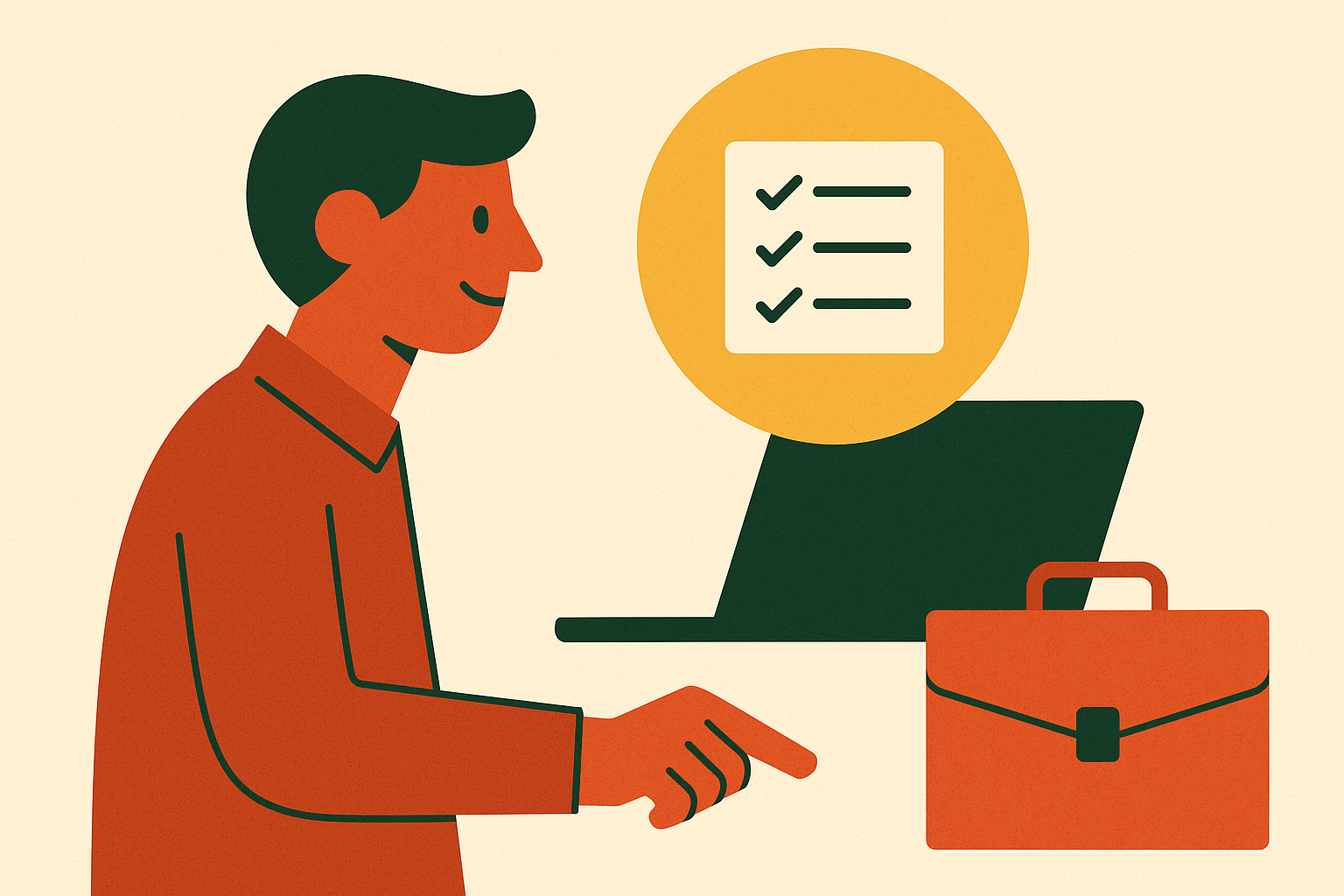
The first hour after a prospect visit determines whether trust closes or disappears.
The first 60 minutes after leaving a prospect's door
Pipeline dies quietly, and it dies after the visit, not during it. The handshake, the demo, the walk-through of the warehouse floor: all of that builds trust in real time. What happens in the days after turns that trust into a signature, or lets it evaporate into a CRM note nobody reads again. Research on sales persistence puts a number on the gap: eighty percent of sales require five or more follow-ups to close, yet forty-four percent of reps quit after a single attempt. Only two percent of deals close on the first contact. The other ninety-eight percent get won or lost in the follow-through, and most reps manage that phase badly, treating it as an afterthought instead of the part of the job where deals actually get decided.
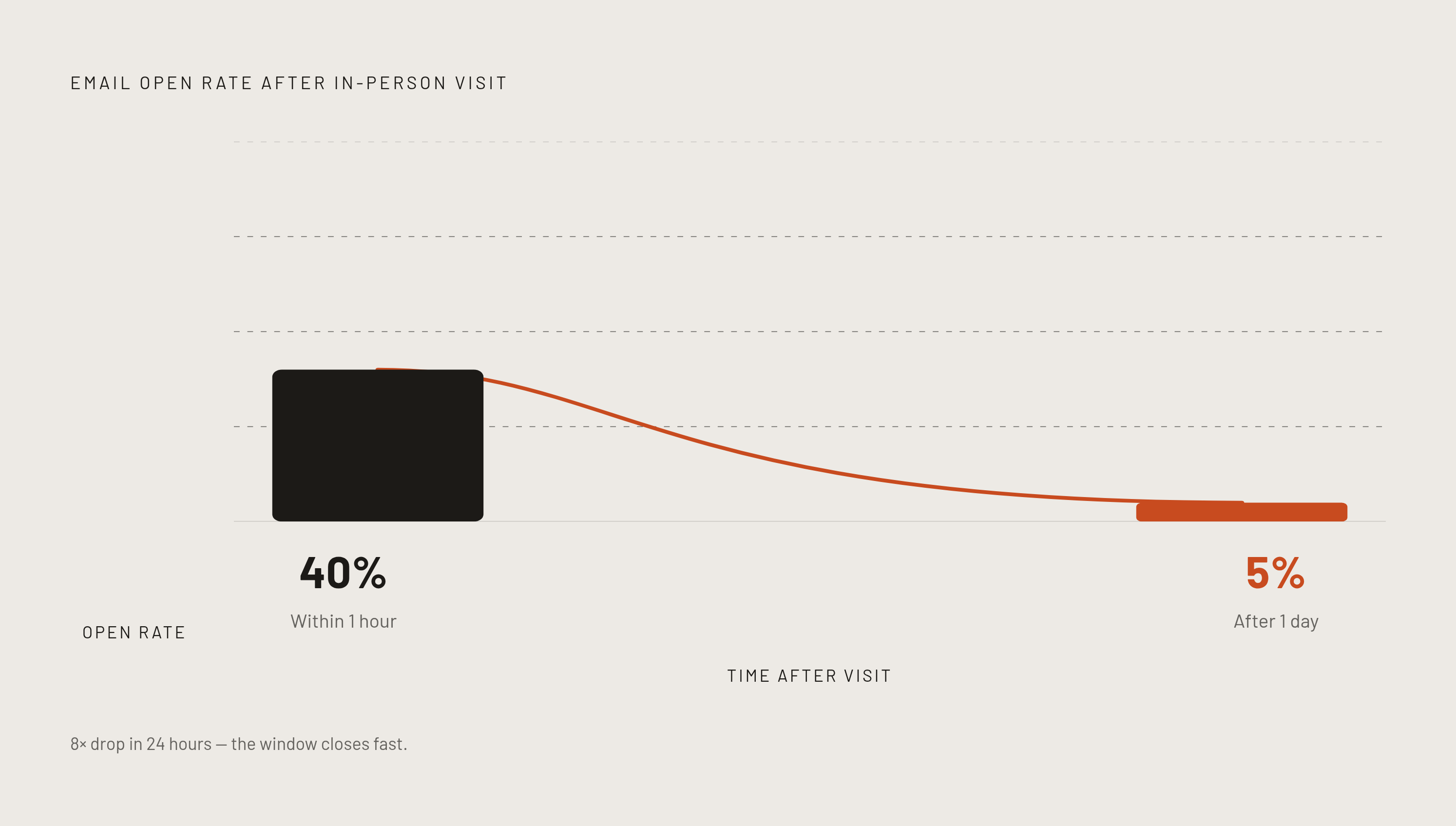
Speed decides more of this than most reps want to admit. A follow-up sent within the first hour of contact gets opened at roughly forty percent. Wait a day, and that number falls to around five percent. That's not a gentle decline; it's a cliff, and it means the rep who "gets to it tonight" has already lost most of the value the visit created.
Competitive pressure explains part of the cliff. Somewhere between thirty-five and fifty percent of sales go to whichever vendor responds first, and an in-person visit hands a field rep a head start a desk-bound competitor doesn't have. That advantage decays fast. Every hour a rep waits to send the recap email is an hour a competitor's inbox blast or cold call gets to land first instead.
Call it the parking lot rule. A follow-up drafted and sent from the car, in the customer's own parking lot, while the conversation is still fresh and the prospect hasn't yet moved on to the next meeting, carries more weight than a polished version composed the next morning at a desk. The content might be nearly identical. Timing is what makes one land and the other get skimmed and archived, so reps who wait for a quiet moment to "write it properly" are optimizing for the wrong variable.
What a structured post-visit cadence looks like across 5 or more touches
The first follow-up gets a rep into the game. It doesn't win it. Closing requires a sequence of touches spaced with intent, not fired off whenever a rep remembers to check the pipeline, and the spacing itself is not a minor detail.
Touches spaced two to three days apart produce reply rates eleven percent higher than daily contact or long, irregular gaps. Daily contact reads as pressure. Gaps that stretch too long read as disinterest, and the prospect drifts to whoever stayed in rhythm. Getting the spacing wrong costs replies directly, which makes it one of the few variables in a sales cadence fully within a rep's control.
Longer sales cycles need a slower rhythm, though few reps adjust for it. The average B2B sales cycle runs close to ten months, so a cadence built for quick wins burns out long before the deal is ready to close. Check-ins spaced every twenty-one to thirty days produce forty-seven percent higher conversion on these longer deals. The logic tracks: sixty-three percent of prospects who request information won't buy for at least three months, so a cadence that gives up at week two never gets the chance to be present when the buying window actually opens.
Channel mix versus message volume after an in-person visit
An in-person visit shouldn't kick off a single email thread that fades into silence, and most of them do exactly that. Data on this is not subtle: omnichannel follow-up, combining email, phone, social, and direct mail, produces purchase rates 287 percent higher than sticking to one channel alone. Sequences that pair email with phone calls see response rates 128 percent higher than email by itself. Reps who treat email as the whole strategy are leaving most of the available lift on the table, and no amount of extra volume on that single channel closes the gap.
Channel-sequencing research from Belkins' outreach data, drawn from more than 46,000 call records and over 112,000 LinkedIn sequences, lays out a logic field reps can apply directly, and it runs in a specific order.
Email goes first, doing the work of scale and context-setting. It delivers the recap, the materials promised during the visit, and the plain record of what got discussed. When email goes quiet, LinkedIn is the second move, and it works because it resets context instead of repeating it. A connection request that references the actual in-person meeting, not a previous email that already went unanswered, produces reply rates well above email alone.
Phone is the escalation layer, reserved for high-value targets. A call placed after a face-to-face visit and a round or two of digital touches isn't a cold call in any real sense, even if the CRM logs it as one, since the prospect has already met the rep and already has a name and a face attached to the deal. If the sequence still hasn't closed, a final low-commitment email keeps the door open without pressure: something as simple as "worth reconnecting next quarter?" costs nothing and keeps the account alive for the next cycle.
Conversation data from the visit and its effect on follow-up touches
An in-person visit is a conversational intelligence event. It generates specifics. The actual objection the plant manager raised about lead times, the budget cycle the CFO mentioned in passing, and the competitor's name that came up unprompted all surface. Most of that detail gets lost within a day if nobody captures it, and the single biggest asset the visit produced quietly disappears with it.
Referencing a prior interaction in a follow-up email increases response rates by sixty-two percent, and that's the specific leverage a field rep holds that a purely digital seller doesn't. Referencing a meeting and referencing a name are not the same move, though, and conflating the two is where most personalization efforts collapse. Personalization limited to a name and company logo produces reply rates of just five to nine percent, barely different from a cold blast. Real personalization means citing the prospect's actual situation, the thing they said, the concern they raised, the number they mentioned. Reps who settle for the name-and-logo version are fooling themselves about what "personalized" actually means.
The mechanics back this up at every level. Personalized subject lines lift open rates by up to fifty percent. Personalized email bodies increase response rates by 32.7 percent over generic copy, and personalized subject lines alone lift response rates by 30.5 percent. None of this works without the underlying detail from the visit itself, and that detail is the constraint most follow-up strategies quietly ignore.
AI coaching tools versus manual review of field visit data
Knowing what good follow-up looks like and actually producing it after every visit, for every rep, on every deal, are two different problems. The first is a training question. The second is an execution gap, and it's the gap where most field sales organizations lose ground, usually without realizing it.
Manual review can't close that gap at scale, and pretending otherwise is where most coaching programs quietly fail. A manager sifting through call notes and secondhand recaps is always working from a degraded version of what actually happened in the room. Conversation intelligence tools built for field data work directly on the raw visit instead. They transcribe and tag conversations against a defined sales methodology, so a manager isn't relying on a rep's memory of how a pitch actually went. They score behaviors against coaching rubrics, catching patterns a rep might not notice, like talking over an objection instead of addressing it. They surface deal-level risk buried in the language itself. A competitor mentioned twice, a stall phrase repeated across multiple calls, and an objection that never got a real answer all become visible. And they generate draft follow-up emails, CRM entries, and action items without a rep sitting down to reconstruct the conversation from a notepad scrawl in the truck.
Mature deployments of this kind of tooling report fifteen to twenty-eight percent lift in win rates on coached deals, alongside a reduction of more than forty percent in the hours managers spend reviewing calls manually. Separately, go-to-market leaders in Highspot's research reported a thirty-six percent improvement in rep win rate from implementing AI-guided sales coaching. Those aren't marginal numbers for an organization running on thin margins and long cycles.
What sales leaders can see and coach when field visit data is captured systematically
Coaching in field sales has a delivery problem, and it's getting worse, not better. A significant share of reps rate the coaching they receive as below average, and that dissatisfaction appears to be growing year over year. Many sales leaders believe they're delivering coaching consistently. Far fewer reps report actually receiving it on a regular basis, and that gap between what leadership believes and what reps experience is its own quiet failure, one that compounds the coaching shortfall rather than explaining it away.
The root cause isn't complicated. Managers can't coach on visits they never saw, and field sales managers physically attend only a small fraction of the total visits their teams run in a given month. A manager who wants to coach a rep's objection-handling has to either ride along in person or trust a secondhand summary, and neither approach scales across a team of any real size.
Systematic capture changes what's visible to a leader and what's remembered by a rep. Real-time pipeline visibility means a manager knows what got discussed, what objections came up, and what got promised to the customer, without waiting for a CRM field to get filled in three days later. Patterns emerge across a full team: which talk tracks convert, which objections keep recurring across accounts, which reps need an intervention before a deal quietly goes cold. Reps take coaching material more seriously when it's a real exchange from a real visit instead of a role-play scenario, because the words on the page are their own. A manager, in effect, becomes present in every conversation a rep has in the field, not just the handful they physically sat in on.
Building the post-visit follow-up system your field team will use
None of this matters if reps won't use it, and this is where most rollouts quietly die. The best-designed cadence in the world fails if it demands ten extra minutes of data entry after every visit, because field reps are driving to the next appointment, not sitting at a desk with time to spare. Systems that ask for more discipline than a busy rep has to give will lose to habit within a week.
Conversation capture has to be automated and mobile-first, happening in the moment rather than reconstructed from memory in a form filled out an hour later. The first follow-up needs a trigger built in, ideally a drafted message a rep can review and send from the parking lot, inside that first-hour window, not composed cold the next morning. Cadence needs structure too: multiple touches spaced two to three days apart in the early phase, stretching to twenty-one to thirty days for the long-cycle nurture phase. Channel sequencing belongs in the workflow itself, email as the anchor, LinkedIn as the reset when email goes quiet, phone reserved for the accounts worth the escalation. Personalization has to draw on the actual conversation data from the visit, surfaced automatically, so the rep references the real objection or the real number instead of typing out a generic recap from memory. And the whole thing needs to sync to the CRM on its own, because a rep forced to choose between sending the follow-up and logging the visit will, more often than not, do neither.
Friction kills adoption in field sales tools, every time, without exception. Any extra step between walking out of the visit and sending that first message is a step some part of the team will skip on a Tuesday afternoon when the next appointment is already running late. The system worth building adds the least friction possible between a real conversation and the follow-up that keeps it alive.
Sources
- 140+ Sales Statistics | 2026 Update - SPOTIO
- Sales Follow-Up Statistics in B2B (2026 Study)
- 74 Important Sales Follow-Up Statistics for 2026
- Sales Follow-Up Statistics and Actionable Strategies for 2026
- saleshive.com
- 11 Sales Follow-Up Strategies: Cadences, Scripts & Examples - SPOTIO
- pipeline.zoominfo.com
- Sales Follow-Ups: A Complete Guide to Increasing Your Close Rates