AI-Powered Action Item Tracking for Field Sales Conversations
AI extracts commitments from field conversations without slowing reps down.
A field rep wraps up a strong visit, shakes hands, walks back to the car, and starts driving to the next stop. Somewhere between that handshake and the next doorbell, the specifics of what got promised, a follow-up quote by Friday, a callback to the operations manager, a sample left at the front desk, start to blur. This is the actual failure mode behind a surprising share of lost field sales deals: not a bad conversation, not a competitor's better pitch, but a commitment that nobody wrote down before it faded. The gap is structural. CRMs were built for someone sitting at a desk between calls, not for a rep standing in a parking lot with five minutes before the next appointment. Fixing that gap, not fixing the reps, is the subject of this piece.
Why manual action item tracking fails field teams
Traditional action item tools share one trait that makes them unsuited to field work: they're passive. They sit there waiting for a human to open them, type into them, and close them again, and that single requirement, an action from the rep, at exactly the moment the rep has the least time and the worst conditions to provide it, is what breaks the whole system. A rep in a car between stops isn't going to compose a clean, structured CRM entry on a phone screen. Typing it out is slow, the autocorrect and small keyboard make it error-prone, and it gets pushed to "later" so often that later never comes. None of that reflects carelessness. It reflects an entry mechanism built for someone else's workday.
Three things have to be true for an action item to actually function: it needs a clear description of the task, a named owner, and a specific deadline. Manual post-visit logging misses at least one of these most of the time, and often misses all three, because a rushed note typed from memory twenty minutes after a conversation rarely captures what was precise in the moment. When that logging breaks down often enough, reps build workarounds: a sticky note on the dashboard, a personal to-do app, a mental tally of "a few things I need to follow up on." Those shadow systems hide real deal risk from managers, and the rep is left juggling a patchwork that nobody else can see or audit.
SPOTIO's State of Field Sales survey found that one in three field sales teams isn't using AI at all, and the teams that are tend to apply it only at the surface: personalizing emails, running basic call analysis, logging straightforward CRM data. The tools that would make the biggest difference, scoring, forecasting, behavior analysis, and automatic action item extraction, remain largely untouched. That pattern makes sense once the entry problem is understood: a team won't adopt strategic AI tools while the basic act of recording a commitment still depends on a rep's willingness to type it in after the fact.
Extracting action items from field conversations without rep burden
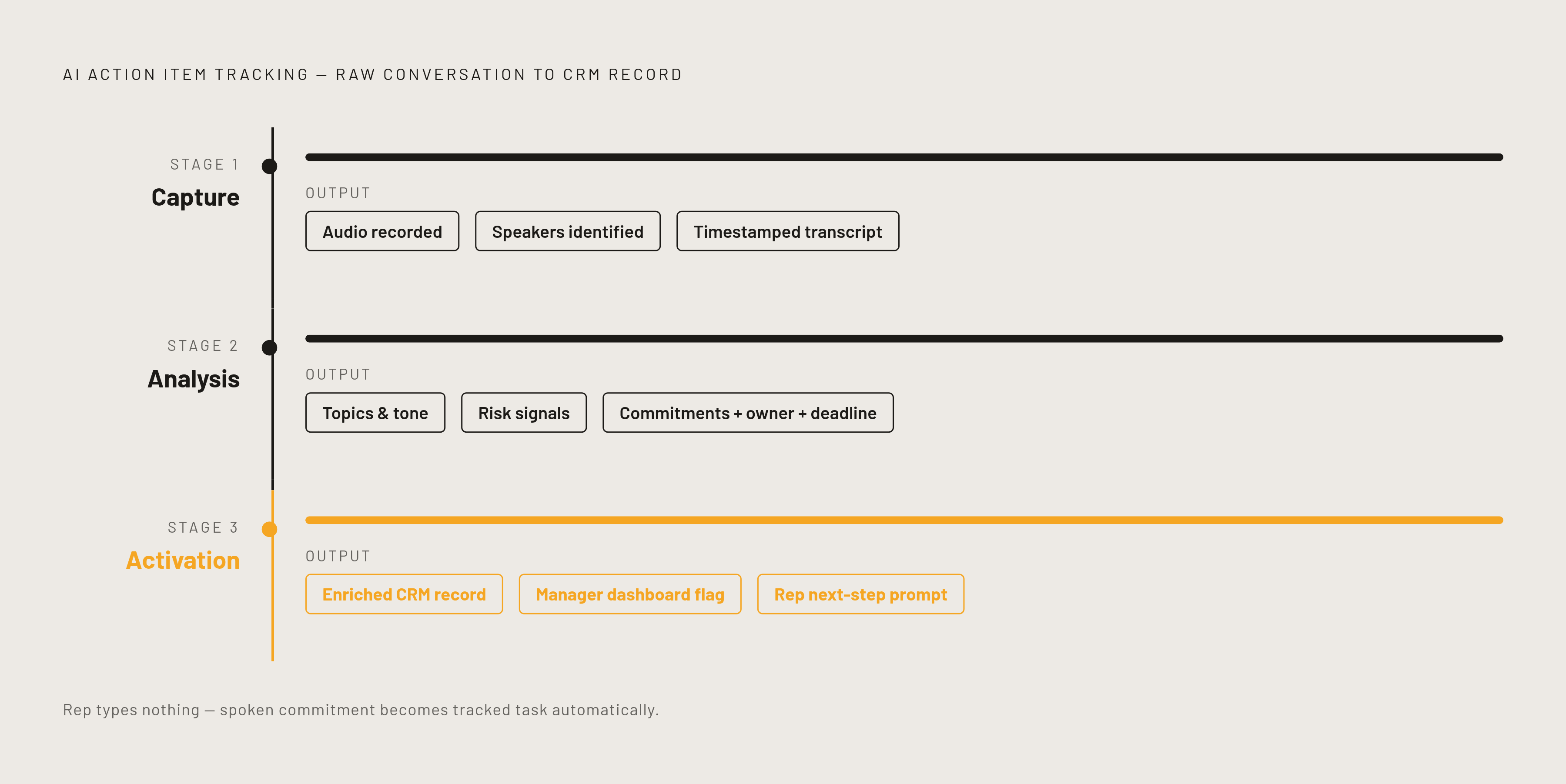
AI-powered action item tracking solves this by moving the extraction step to the moment the conversation happens. You can break the work into three layers, and each one matters on its own.
The first layer is capture. Software records the audio, it identifies who's speaking, and it produces a timestamped transcript in real time, not as an overnight batch job. Quality at this stage isn't optional: a garbled transcript or a misattributed line corrupts everything built on top of it, turning a real commitment into a missed one or an honest objection into a false coaching signal for a manager reviewing the call later.
The second layer is analysis. Natural language processing goes through the raw transcript and pulls out topics, shifts in tone, mentions of competitors, pricing objections, and signals that a deal is at risk. This is the layer where commodity transcription turns into something more useful: structured commitments, each with an owner and a deadline attached, rather than a wall of text someone still has to read and interpret.
The third layer is activation. The extracted action items flow back into the CRM as enriched deal records, show up on a manager's dashboard as flagged moments worth attention, and appear in the rep's own workflow as next-step prompts, and the rep never has to type a single word.
For field reps, the mobile constraint shapes every decision in building a tool like this. Connectivity drops constantly in basements, rural routes, and buildings with thick walls, so the tool has to capture locally and sync cleanly once a signal comes back. Thumb-friendly design matters because nobody's opening a laptop between doorbells. A rep runs a tool all day, so it can't drain the phone by noon. None of these are nice extras. If a tool lags, drains the battery, or buries capture behind a multi-step menu, it gets abandoned the same way manual CRM entry did. Done right, the rep loses the burden of documentation entirely, and the commitments made out loud in conversation turn into tracked tasks on their own.
What AI conversation intelligence platforms do with field conversations
The platforms building this capability differ mainly in timing, whether they act before, during, or after the conversation, and that timing changes how much value actually gets recovered.
Post-call tools work as a review layer. Fireflies.ai records and summarizes sales calls automatically, turning conversations into searchable transcripts synced to the CRM, which suits teams that want to search back through what was said and pull action items out after the fact. Coffee's AI agent joins calls on Zoom, Teams, and Google Meet, transcribes them, extracts action items and next steps, and pushes them into Salesforce or HubSpot; its Pipeline Compare feature gives a week-over-week view of which deals moved forward, which stalled, and which showed up newly in the pipeline. Tools like these recover data that would otherwise disappear once the call ends, but they act after the moment of influence has already passed. The conversation is over by the time the insight arrives.
Real-time platforms work differently: they act as a co-pilot during the conversation itself. One real-time conversation intelligence platform analyzes meetings as they happen, surfacing coaching moments and relevant content cards live, then generating recommended next steps and deal-risk flags once the call ends. A tool working in real time can flag a commitment as it's being made or notice an objection that never got answered, while the rep and the prospect are still in the room together. For field sales in particular, this is the highest-leverage point to intervene: the rep is standing right there, the prospect is right there, and whatever gets promised can be confirmed and logged in that moment instead of pieced back together from memory an hour later.
SPOTIO occupies a third category, built specifically for the mechanics of outside sales: a field execution platform with an AI co-pilot and predictive next-best-action guidance, designed for reps working out of trucks, off doorsteps, and from parking lots where desk-centric software simply doesn't function. Field-specific platforms like this handle the offline reliability and mobile design that rule out many otherwise capable conversation intelligence tools. Each of these approaches, post-call review, real-time coaching, and field-built execution, serves a real purpose; the value just compounds the closer the tool gets to the actual moment the commitment is made.
What managers gain from tracked field conversation records
Shift the view from the rep to the manager, and the same automation solves an entirely different problem: visibility. Sales managers review only a very small fraction of all sales calls, so most of the conversation data a team generates goes completely unused. What that means in practice is that managers end up coaching based on the calls they happened to sit in on or the deals a rep chose to flag, which is a thin and biased sample of what's actually happening across a territory.
Automated action item tracking turns every single field visit into a data point, whether or not a manager was anywhere near it. Territory coverage, deal stage movement, how reliably commitments get followed through on, and recurring objection patterns all become visible, and no rep has to fill out a spreadsheet. Outreach's Deal Agent uses conversation intelligence to recommend updates to opportunity records, so pipeline accuracy improves; apply that same logic to field conversations, and pipeline visibility stops being a separate administrative task, it just falls out of the rep's normal workday.
The coaching conversation itself changes shape once this record exists. A manager no longer has to ask "how did that visit go?" and take whatever answer comes back at face value. The manager can instead ask: "You made a pricing commitment on Tuesday, and it's Thursday. What happened?" That question is grounded in a specific, timestamped moment rather than a rep's memory of how things went, and it opens the door to automated coaching playbooks that scale across a whole team: if a rep consistently skips a discovery question or never locks down a firm next step, the pattern appears in the data, and the platform can show how top performers handle that same moment, and what used to be invisible, the actual content of a field visit, becomes something a manager can observe directly.
Tracked commitments, shorter deal cycles, and protected close rates
None of this matters as an efficiency exercise on its own. It matters because untracked commitments cost deals, and tracked commitments win them, and that causal chain runs in a straight line. A deal with no tracked next step is stalled, and invisible, because nobody on the selling team knows it's stalled until the prospect has already moved on. From the prospect's side, a rep who goes quiet after promising a follow-up doesn't read as busy. It reads as disorganized, or worse, uninterested, and that impression is often what actually ends a deal, not the pricing or the competitor.
Reliable follow-through does the opposite: it builds trust with a prospect at the moments trust is being tested, and that difference raises close rates. SPOTIO's 2026 State of Field Sales research finds that manual CRM entry and administrative overhead drain a field rep's time more than anything else, so they stand between reps and more hours spent actually selling. Automating the follow-up and action item capture hands that time back directly.
There's a compounding benefit once every commitment is tracked consistently: managers can start telling systemic problems apart from one-off situations. A rep who never confirms a next step across dozens of visits has a coaching problem. A single deal that went quiet right after a pricing conversation has a deal-specific problem. Both look identical from the outside without tracked data, but you need a very different intervention for each. Coffee's Pipeline Compare feature, which shows week-over-week which deals progressed, stalled, or appeared newly in the pipeline, is a concrete example of how a tracked record turns a vague sense that "some deals are stuck" into a specific, actionable list. With that kind of visibility, teams can catch a stalling deal and intervene while there's still time to save it, rather than discovering the loss after the fact in a forecast review.
Field-ready AI action item tracking tool requirements
Most AI conversation intelligence tools on the market were designed with a desk-based team in mind, and several of the features that make a tool powerful in an office become exactly the features that get it abandoned in the field. If you evaluate a tool against field-specific conditions, you can tell the ones reps will actually use from the ones that quietly die on a rep's phone within a month.
Does the tool keep working when connectivity doesn't? Field reps spend real time in basements, rural stretches, and buildings that block a signal entirely, so the tool needs to capture locally when the connection drops and sync cleanly, without creating duplicates or overwriting other updates, once it returns.
Can a rep use it one-handed, in sunlight, without typing much? Thumb-friendly design, minimal manual entry, and a screen that's actually readable outdoors aren't extras. If capturing an action item takes a laptop or a multi-step menu, it won't get used in the field no matter how good the underlying AI is.
Does it act in real time, or only after the call ends? Post-call tools recover data that would otherwise be lost. Real-time tools stop the loss before it happens. For field sales, where the rep has no way to return to a conversation that's already over, real-time or immediate-post-visit extraction carries more weight.
What does "connects with your CRM" actually mean? The phrase gets used loosely across the category. What matters is two-way sync, mapping that respects the CRM's actual fields, and data that stays current, not a nightly export that leaves someone reconciling two versions of the same deal the next morning.
Does the rep have to do anything to trigger it? Any tool that depends on a rep remembering to tap a button or open an app at the right moment will fail the same way manual CRM entry failed. The extraction needs to happen automatically, as a byproduct of the conversation itself, not as a separate step layered on top of it.
Does the manager get anything without asking for it? Pipeline visibility and coaching dashboards should show up on their own from the rep's normal activity, so nobody needs a separate reporting exercise for them. A vendor worth evaluating should be able to show territory-level and rep-level insight generated automatically, with no additional data entry from either side.
Putting it together: a field sales team where no commitment falls through the cracks
None of this is about adding one more tool to a rep's already-crowded stack. It's about building a system where the rep's normal, unscripted way of talking to a prospect automatically produces the accountability infrastructure the rest of the team depends on. In the state this piece has been building toward, a rep finishes a field visit, the commitment made during that visit gets captured in real time, the CRM updates on its own, the manager sees the next step the moment it's created, and the prospect gets timely follow-through, all without the rep ever opening a note-taking app or typing a word. The conversation itself becomes the record.