Stalled Deal Recovery Tactics in Field Sales Pipelines
Stalled deals reveal diagnostic patterns reps can fix without another generic follow-up.
Stalled deals cost B2B sales organizations more than lost revenue. They cost forecast accuracy, rep capacity, and the integrity of every win-rate number leadership uses to make hiring and coaching decisions. SpurIQ's research defines a stalled deal as an opportunity that stops moving without ever getting marked won or lost: it sits in CRM at full value, the close date keeps drifting, replies slow to a trickle, but nobody pulls the plug. That distinction matters, because a deal that's actually dead behaves very differently in a pipeline review than one that's alive but stuck, and treating them the same is where most recovery efforts go wrong.
The scale of this isn't a rounding error. Between 40% and 60% of B2B pipeline disappears into no-decision every year, and the Ebsta 2026 B2B Benchmark found that 57% of forecasted deals either slip a quarter or go dark entirely. Prospeo's research, cited by SpurIQ, puts the number of B2B buyers who report experiencing a stalled deal in any given year at 89%. Combine that with a market where average win rates have fallen to just 19% (pixelwand.io) and sales cycles now run 21% longer than they did in 2020 (Outreach), and the picture is structural, not seasonal. Fewer deals close, they take longer to get there, and the ones that stall in the middle are eating capacity that could be spent on fresh pipeline instead.
The instinctive response to a quiet deal is more outreach: another email, another check-in call, another "just following up." That instinct is almost always wrong, and it's the starting assumption this piece works to dismantle.
The four root causes that account for nearly every stalled field deal
Deals don't usually stall because a rep didn't try hard enough. They stall because of specific, buyer-side conditions that no amount of generic follow-up will resolve, a point made clearly in Mentor Group's work on pipeline recovery. Treating every stall as an effort problem is why so much recovery activity produces nothing.
These root causes account for nearly all of it, and each produces a signal visible in the conversation before it appears cleanly in CRM.
Lost urgency, or no compelling event, describes when the buyer agrees the problem is real but isn't moving on it. "We'll circle back" "We'll circle back" starts appearing on every call. In CRM, the tell is a close date that's already slipped once and a next step with no buyer name attached to it.
Unclear decision path describes when the rep has a champion, but no visible line from that champion to a signature. Decisions get described vaguely as "internal." The CRM tell here is stark: no economic buyer has ever been on a call, and there's no mutual action plan documenting what happens next.
Late or hidden stakeholders describes when IT, security, or procurement shows up weeks or months after the champion relationship started. CRM shows a new contact added late in the cycle, often paired with a sudden spike in how long the deal has sat in its current stage.
Process or risk gap describes when the buyer keeps asking for more, another demo, another pilot, another round of information, without ever naming a decision date. Stage duration blows past whatever's normal for that sales cycle, and the recorded next steps read like placeholders: "send info," "follow up."
A reliable diagnostic cuts through a lot of this fast: has the rep ever spoken directly with the economic buyer, and can the champion articulate, in financial terms, what it costs the company to not solve this problem? If the champion resists introducing the rep to the economic buyer, that resistance is itself the data point, it usually means the champion doesn't have the internal weight the rep has been assuming they do.
Mentor Group's recommended threshold for flagging a stall is 14 to 30 days of no meaningful activity, depending on the length of the sales cycle. Below that threshold, patience is reasonable. Above it, the deal needs a diagnosis, not another touch.
How stakeholder complexity drives stalls in field deals specifically
Gartner data, cited via sendspark.com, puts the average B2B buying group at 6 to 10 stakeholders for complex purchases, reaching 20 or more for large enterprise deals. Buying committees grew from roughly 5.4 people in 2015 to somewhere between 8 and 13 by 2025. Every deal a field rep works today is, structurally, a negotiation with a small committee, whether or not the rep has met more than one of its members.
That's the specific trap field sales falls into. An in-person visit creates a strong, warm feeling of relationship, and that feeling is often built with exactly one person, a champion who may have influence but no budget authority and no cross-functional pull. The 2025 Edelman and LinkedIn B2B Thought Leadership Impact Report calls these unmet decision-makers "hidden buyers," internal influencers who almost never appear in the sales cycle itself, yet who shape buying decisions significantly.
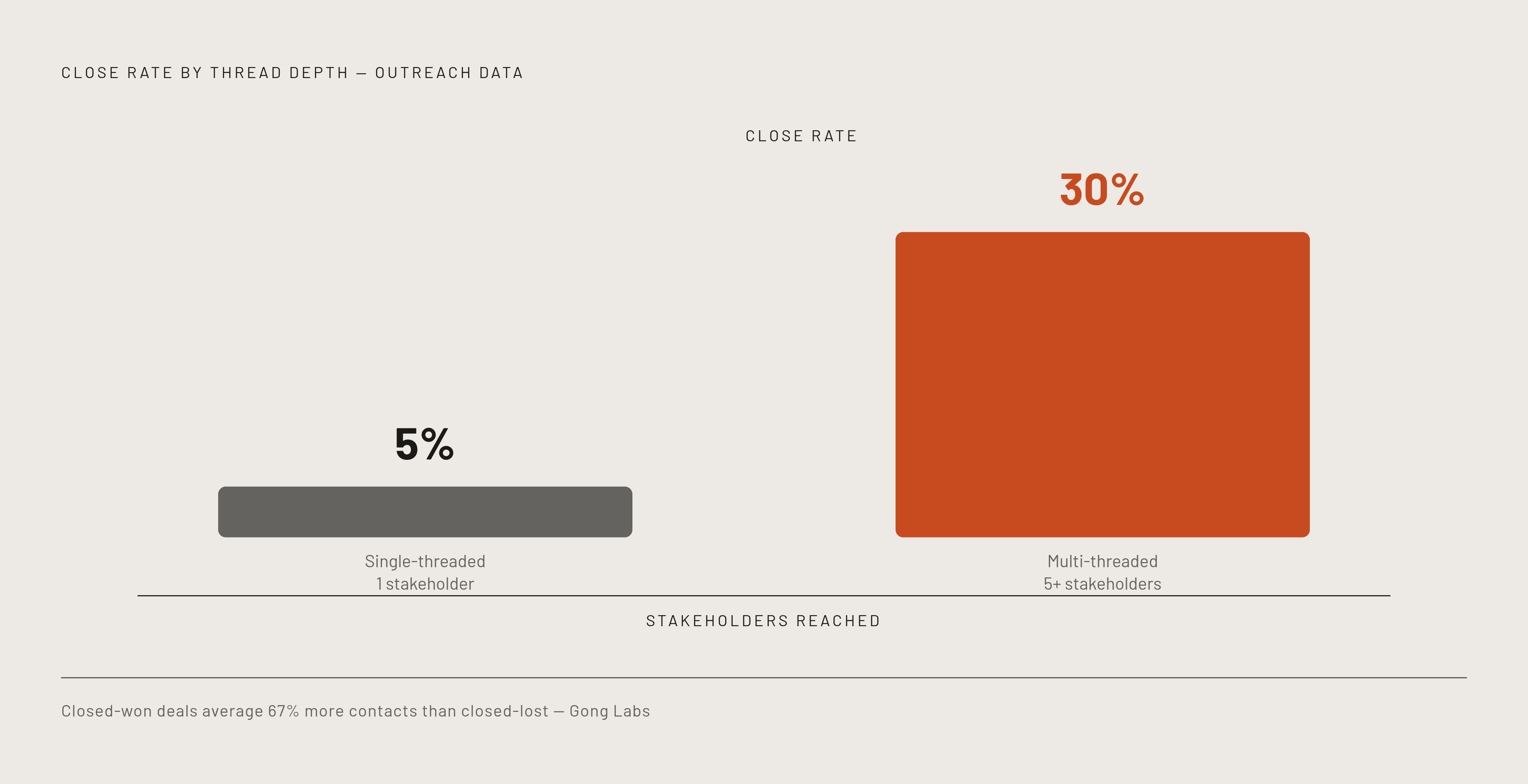
The data backs up how costly this is. Gong Labs' research found that closed-won deals average 67% more contacts than closed-lost deals. A rep working one relationship, no matter how strong, is competing against a structural disadvantage baked into the deal from the start. Outreach's data shows the mechanism: reaching five or more stakeholders is associated with a 30% close rate, compared to just 5% for single-threaded deals, and simply engaging more than one contact makes a deal 37% more likely to close.
Field multi-threading isn't the same motion as inside sales multi-threading, and treating it that way is a mistake. It isn't a matter of blasting more emails to more names on an org chart. It requires earned introductions, a real strategy for getting executive access, and enough discipline to avoid sending contradictory messages to different people inside the same account, a nuance that research on multi-threading flags directly. If a champion pushes back on introducing the rep to an executive, that's not a sign of a protective, engaged relationship. It's a stall signal wearing a friendly disguise.
Matching the recovery tactic to the diagnosed root cause
Recovery tactics that don't match the underlying cause don't just fail to help, they actively signal desperation to the buyer. Every tactic below exists to address a specific condition, not to manufacture activity against silence.
Lost urgency calls for rebuilding the cost of delay. Re-quantify what it actually costs the buyer, in dollars, to keep not solving the problem, and tie that number to a date the buyer controls: a fiscal year-end, a product launch, a competitive window closing. The conversation needs to shift away from the vendor's features and onto what changes, concretely, if nothing changes. Field sales has a tool inside sales doesn't: a leadership visit. Deployed deliberately, not as a check-in, an in-person visit from the seller's own executive can reset urgency in a way no email sequence ever will.
An unclear decision path calls for a mutual action plan. Map the actual decision process, name every stakeholder, and document every approval gate and who signs at each one. A mutual action plan works because it forces the champion to name each individual step rather than nodding along to a vague "next step." If the deal is stalled but still qualified, Brooks Group's guidance is to push the rep to find more contacts inside the organization, framed as a "strategy session" that surfaces who else needs to weigh in. That framing does double duty, since it also gives the champion internal cover for pulling more people into the conversation.
Late or hidden stakeholders call for multi-threading before the stall happens, not after. Any deal with a single engaged contact and a deal size large enough to require committee sign-off should be flagged as structurally at risk from day one. Field reps have a real advantage here: an in-person visit makes a "team briefing" or "executive alignment meeting" a natural ask, and it's a much harder ask to decline face to face than by email. For deals already stalled because a late stakeholder showed up, pull the risk work forward. Get the security review, the procurement packet, and the technical validation moving now, and make the next step a risk-reduction action instead of a sales action.
A process or risk gap calls for removing friction, not adding information. If the buyer keeps requesting more material without committing to anything, the issue was never information volume. Nobody has made the decision feel safe yet. Brooks Group's approach here is counterintuitive but sound: send something of genuine value, an industry insight or a piece of relevant research, without asking for anything back. It reopens the conversation without pressure and often surfaces the real hesitation the buyer has been avoiding naming. According to Brooks Group's research, a handwritten note or a physical package reaches a senior decision-maker through a channel with almost no competition for attention. It's a tactic suited to late-stage, high-value deals where warmth closes deals volume can't reach.
None of this works as an open-ended effort. Mentor Group's rule is that every recovery attempt has to end in one of three outcomes: the deal re-enters a clear decision path, it gets parked with a specific re-entry trigger and review date, or it gets closed out. Following up indefinitely without picking one of those three is a habit standing in for a strategy. It's a habit standing in for one.
What pipeline reviews need to look like when deals are stalling regularly
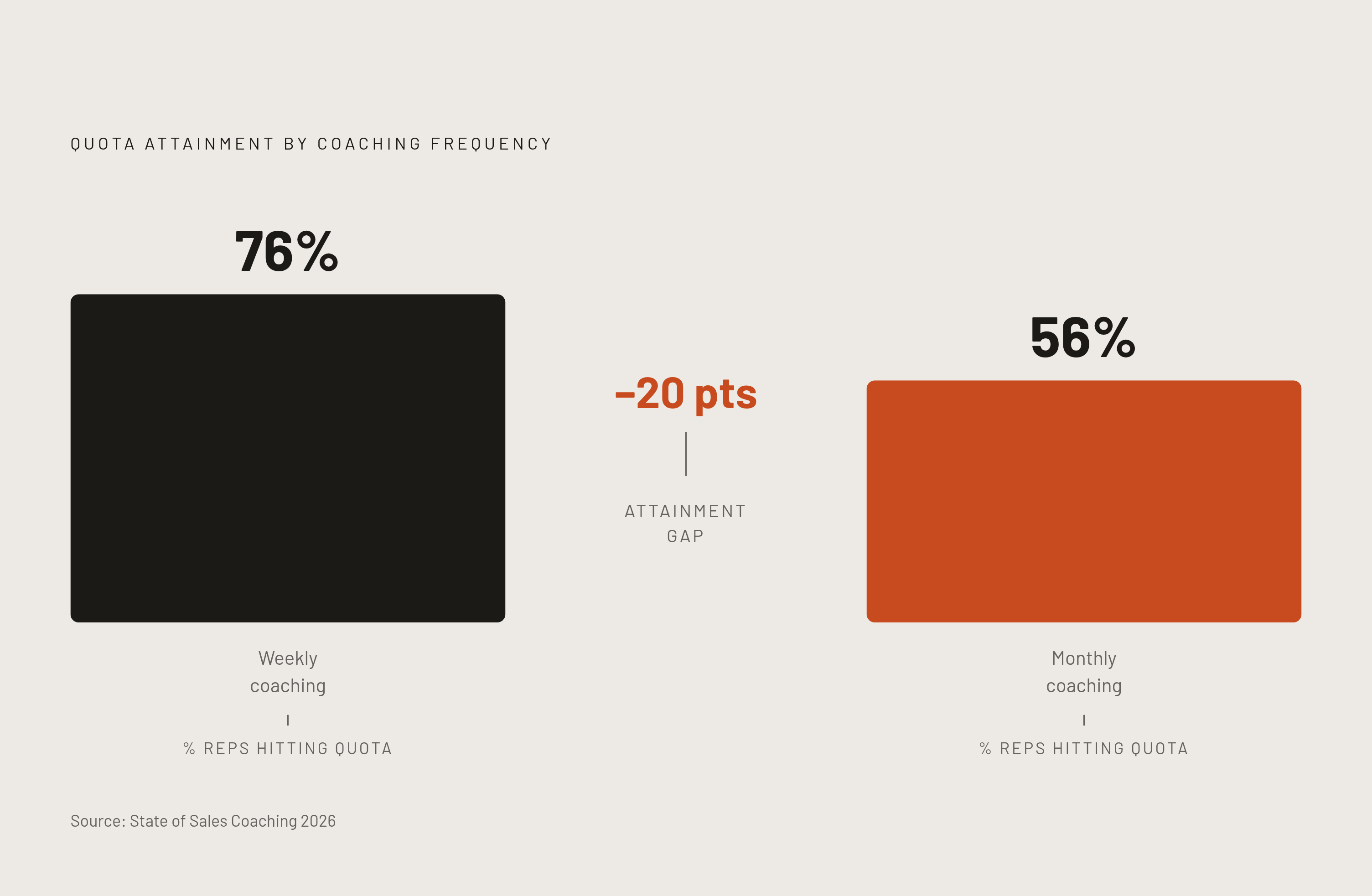
Coaching cadence isn't administrative overhead, it's a direct performance lever. The State of Sales Coaching 2026 report, cited by getaccept.com, found that reps coached weekly or more hit quota at a 76% rate, while attainment drops to 56% once coaching slows to monthly. That's a 20-point swing tied to frequency alone.
The cadence that multiple sources, including gain.io, converge on runs in two tiers, plus a lighter daily layer. Weekly one-on-ones, 30 to 45 minutes, should go deep on three to five high-value or at-risk deals rather than skimming across the whole pipeline. Monthly leadership reviews are where coverage ratios, stage conversion trends, and broader patterns belong, not individual deal status. Short daily standups of 10 to 15 minutes work well as momentum check-ins on energy and blockers, not as another round of status updates.
The most common failure mode, flagged by pipeline.zoominfo.com, is managers turning the weekly one-on-one into a pipeline review by default. Asking "where does this deal stand?" is deal inspection. It isn't coaching, and it doesn't change how the rep handles the next deal that stalls.
The better question is narrower and does more work: "Walk me through your highest-risk deal. What's the next step, and who else needs to be involved?" One question, and it forces the rep to show their hand on stakeholder coverage, next-step clarity, and close-date realism all at once. If the rep can't name the economic buyer on that deal, that's the coaching moment right there, not a follow-up question later.
Gartner's research found that 70% of sales reps forget training content within a week without reinforcement. Reinforcement delivered inside a weekly review, tied to a live deal the rep actually cares about, sticks in a way a training session months earlier never will.
Some organizations are formalizing this into a pipeline governance charter, a document spelling out review standards in plain terms: next steps updated promptly after a key meeting, and deals sitting too long in one stage automatically triggering manager review. An ICP-based triage model is worth folding into that same governance layer: accounts that closely match ideal customer attributes justify full field investment, while weaker matches should earn a field visit only after budget, authority, and timeline are already qualified. Pipeline reviews should be enforcing that line, not rubber-stamping whatever a rep has already added to the field calendar.
How conversation data surfaces stall signals before they appear in CRM
CRM data lags reality because reps update it based on their own confidence, not on what the buyer's actually doing. By the time a stage reflects the truth, the window to recover the deal has often already closed.
Conversation intelligence closes that gap by reading the language itself. Research from thequantumleap.business, 2026, found that specific word patterns cluster reliably around outcomes: "exploring," "circle back," and "internally discussing" appear disproportionately around deals that end up lost, while "next steps," "evaluation team," and a specific date appear around deals that close. SpurIQ's research puts a number on how much earlier this kind of signal appears: 30 to 60 days ahead of what CRM alone would flag. The specific tells to watch for include no champion contact in 14 days, no executive ever appearing on a call, a competitor's name coming up three times in one call with no rebuttal from the rep, and a shift in email reply tone or reply latency.
Thequantumleap.business's research finds that modern AI call coaching platforms do more than flag risk after the fact. They transcribe and tag conversations against a defined sales methodology, score rep behavior against a rubric, surface deal-level risk from language patterns, and, as of the 2025-2026 generation of tools, execute follow-up actions directly, drafting emails and updating CRM fields without a rep touching either.
Field sales has historically sat outside this entirely. Conversations happen in person, in a parking lot, at a site visit, in a hallway after a meeting, and none of it gets recorded or analyzed the way an inside rep's calls do. Mobile-capture platforms built specifically to close that gap give managers visibility into conversations they were never physically present for, which matters more in field sales than almost anywhere else in the funnel. Real-time, in-call coaching, guidance on stakeholder handling or urgency language delivered while the conversation is still happening, represents the next real shift for field teams: preventing the stall in the moment rather than diagnosing it weeks later.
The platform landscape reflects a few distinct approaches. Gong's AI assistant summarizes a deal across every touchpoint, calls, emails, CRM history, and drafts follow-ups that reference actual commitments made on a call, while identifying risks visible in the deal, like a missing stakeholder or a stalled mutual action plan. Pricing is at the high end of the market: knowlee.ai's 2026 research puts fully loaded enterprise cost well above $1,000 per user per year, with seat minimums and multi-year commitments standard, pushing total cost past $250,000 annually for a 50-person sales organization. Chorus, part of ZoomInfo's platform per avoma.com, analyzes calls and meetings to surface coaching opportunities and deal risk within that broader ecosystem. Neither was built with field sales as the primary use case, which leaves room for tools designed around mobile capture and real-time, in-person coaching specifically, addressing the adoption problem that desktop-first tools create for reps who spend most of the day away from a keyboard.
Building a repeatable system so stalls become an exception, not the norm
The concentration of performance in B2B sales is stark: pixelwand.io's research shows 14% of sellers driving 80% of revenue, and top-performing teams moving pipeline roughly 11 times faster than teams at the bottom. That gap isn't explained by raw talent. It's explained by process, specifically whether stall diagnosis happens systematically or gets left to individual rep instinct.
Everything in this piece points to the same underlying shift: stop treating a quiet deal as a signal to send another email, and start treating it as a diagnostic problem with four possible answers. A team that can name, on sight, whether a stall is urgency, path, stakeholder, or friction has a repeatable system. A team still defaulting to "just follow up" has an instinct, and instinct doesn't scale past the handful of reps who happen to be good at it.
The tools now exist to catch these signals in the conversation itself, weeks before CRM would ever show them. The management cadence exists to turn a stalled deal into a coaching moment instead of a write-off. The remaining variable is whether an organization builds the discipline to use both consistently, on every deal, not just the ones a manager happens to notice are running late.