Multi-Stakeholder Selling in Complex Field Sales Deals
Buying committees now decide deals, and reps must thread multiple stakeholders to close.

Field sales used to run on relationships between two or three people who could hash out a deal over coffee. That era is over. The average B2B purchase now pulls in 13 internal stakeholders and 9 external participants, a scale of coordination that no rep can manage by memory or gut instinct. Public sector deals push even further, averaging 14 internal stakeholders, and anything touching AI capabilities increasingly draws security, legal, and data governance teams into the conversation.
The numbers get more specific once dollar signs enter the picture. Deals north of $50,000 run committees averaging 11.2 to 12.5 stakeholders, and the broader trend line for complex B2B solutions has climbed to 8.2 stakeholders, up 21% since 2015. That's a curve still bending upward, not a plateau, and the reason has as much to do with who's making decisions as how many people are involved. That's a curve still bending upward, and the reason has as much to do with who's making decisions as how many people are involved.
Age is doing a lot of the work here. Decision-makers under 40 involve nearly twice as many stakeholders (6.8) in a purchase as their older counterparts (3.5), and Millennials and Gen Z now make up 71% of B2B buyers. Younger buyers default to consensus-building as a habit. The committees reps face today are going to keep growing before they shrink. Improvisation was never a great strategy. Now it's mathematically unworkable.
The buying committee's role in killing deals and field rep strategies for handling it
Deals don't usually die because a competitor outmaneuvered the field rep. They die because the buying committee never reaches internal agreement, full stop. Between 40% and 60% of qualified B2B pipeline stalls for exactly this reason, meaning "no decision" beats out every rival vendor combined. That single fact should reorder how sales leaders think about competitive threat.
Stalling is closer to the default. It's closer to the default. Some 86% of B2B purchases stall at some point during the buying process, and even the deals that close often don't feel like wins to the buyer: 81% report dissatisfaction with the provider they ultimately chose. A closed-won deal in the CRM can still represent a buyer who never fully aligned internally, and that misalignment tends to resurface later as churn or a rocky implementation.
Part of the reason stalling has become so common is where approval authority now sits. Some 79% of purchases require CFO sign-off, and 52% of buying groups include someone at VP level or above. The financial and executive layer isn't an occasional hurdle anymore; it's baked into nearly every deal of consequence.
Buyers want autonomy, and they're using it before a rep ever gets a meeting. Some 95% of winning vendors are already on the shortlist before first contact happens. So by the time a field rep walks into that first conversation, the committee has largely finished its independent evaluation. The rep isn't there to introduce the product. The rep is there to navigate a consensus process that's already underway, often invisibly, and that changes what "selling" actually means in a field context.
What multi-threading means in a field sales context
Multi-threading means building active, maintained relationships with multiple members of a buying committee at the same time. It means separate, substantive conversations with the CFO, the ops lead, and the end user, each one addressing what that person actually cares about. Knowing who the stakeholders are isn't threading. Talking to them, repeatedly, is.
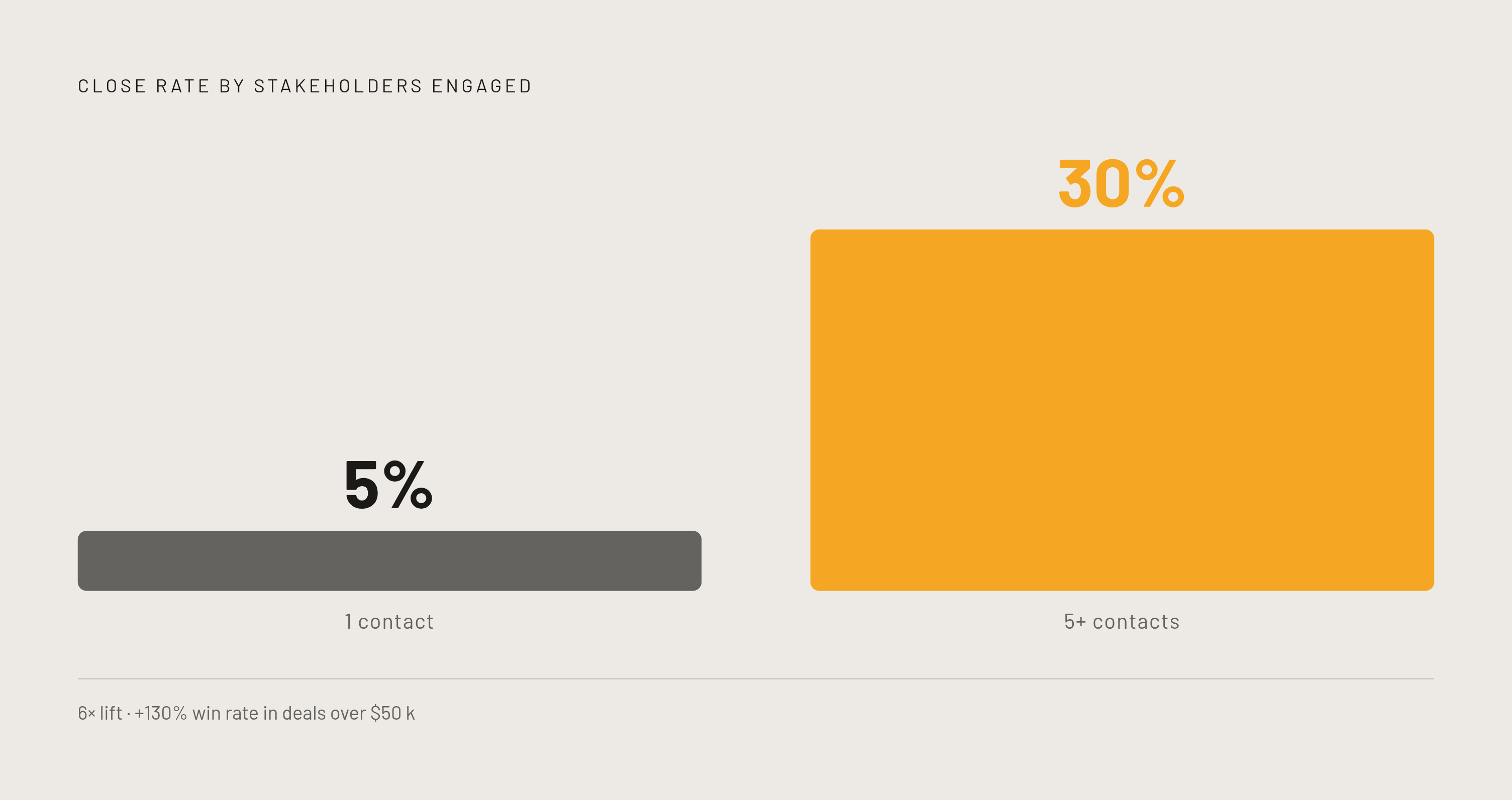
The performance gap between single-threaded and multi-threaded deals isn't subtle. Deals with a single contact in the CRM close at around 5%. Deals with five or more stakeholders actively engaged close at 30%, a sixfold difference that ought to reset how sales organizations measure pipeline health. Other data points in the same direction: multi-threading lifts win rates by 130% in deals over $50,000, and threading across departments (not just up a single chain of command) increases win rates by 56%.
And yet, despite data this lopsided, 70% of B2B opportunities still show only one point of contact in the CRM. The fix is well understood, the payoff is well documented, and most organizations still aren't doing it, which is the structural failure multi-threading is built to fix.
Mapping stakeholder before walking in the door
Stakeholder mapping is intelligence-gathering, done in advance, aimed at answering a specific set of questions: who's the economic buyer, who's the technical evaluator, who actually uses the product day to day, who's a... It's intelligence-gathering, done in advance, aimed at answering a specific set of questions: who's the economic buyer, who's the technical evaluator, who actually uses the product day to day, who's a likely champion, and who's positioned to block the deal from the inside.
Each of those roles carries a different set of concerns, and conflating them is where a lot of reps go wrong. CFOs and finance stakeholders care about ROI, cost containment, and where a purchase lands in the budget cycle; given that 79% of purchases require their approval, their objection is rarely about the product itself, it's about financial exposure. Operations stakeholders worry about workflow disruption, how complex implementation will be, and how much adoption burden lands on their team. C-suite executives think in terms of strategic fit, competitive risk, and organizational change management. End users care about something much more immediate: does this make the job easier or harder, and how much training does it take to get there. Legal, security, and data governance teams are focused on compliance exposure, liability, and vendor risk, concerns that used to be an afterthought and are now a gating factor on almost any deal involving AI or sensitive data.
Frameworks exist to keep this organized, and MEDDPICC has emerged as the dominant one for inspecting complex, multi-stakeholder deals: Metrics, Economic Buyer, Decision Criteria, Decision Process, Paper Process, Identify Pain, Champion, and Competition. MEDDIC and CHAMP cover similar ground and both outperform BANT once a deal involves more than a couple of decision-makers, mostly because BANT was built for a simpler buying era.
None of this mapping matters for its own sake. The point isn't a complete org chart pinned to a wall. The point is finding the gaps: which stakeholders haven't been reached yet, which concerns are sitting unanswered, which relationships are thin enough to collapse under pressure.
Building an in-person conversation strategy for each stakeholder type
Each stakeholder needs a distinct value proposition tailored to what that person cares about. The conversation with a CFO is about risk and return. The conversation with operations is about implementation and disruption. The conversation with an end user is about whether their daily work gets easier or harder. Treating these as one conversation with minor variations is how reps lose committees they never realized were split.
This isn't a new insight, and established sales methodologies have built entire training programs around it. Integrity Solutions' Navigating the Complex Sale® workshop trains sellers explicitly to tailor value propositions to each stakeholder's priorities, map the buying network, earn access to executives, and neutralize the people positioned to block a deal. Miller Heiman's Strategic Selling with Perspective covers similar ground: multi-threading, influence mapping, coalition building, and aligning value across stakeholders who often have competing agendas and different tolerances for risk.
The data shows the payoff for doing this well. Tailoring content to the specific priorities of a buying committee meaningfully increases consensus in decision-making, a significant lift in an environment where the stall rates above show the default outcome is disagreement or drift.
Where consensus breaks down, according to conversation data
Coaching in field sales has historically been thin. Manual call reviews, the occasional ride-along, and generic training programs capture only a sliver of what actually happens in real sales conversations, and what they do capture rarely gets translated into feedback specific enough to change behavior. That gap matters more now than it used to, given how much of the deal now hinges on navigating a dozen-plus stakeholders rather than closing a single decision-maker.
The coaching gap raises stakes early, visible in onboarding. Research finds that a large majority of new hires say one-on-one time with their manager is the most important part of onboarding, yet most sales managers don't have the bandwidth to deliver coaching at the level of individual conversations, especially across a team juggling multi-stakeholder deals simultaneously.
Conversation intelligence platforms are starting to close that gap. Tools that transcribe and analyze in-person and field sales conversations surface deal-level risk signals in the transcript: which stakeholder expressed hesitation, which objection got raised and never actually answered, which next step was left vague or never scheduled. Real-time coaching takes the idea a step further. Instead of reviewing a conversation after the fact, live prompts during the meeting let a rep adjust a discovery question, respond to an objection while it's still fresh, or push for a concrete next step before the moment passes and the opportunity goes cold.
Staying present across every stakeholder conversation sales leaders cannot attend
Visibility is the structural problem. A significant share of forecasted deals slip or go dark every quarter, and many revenue leaders point to unreliable forecast data as a major source of lost revenue. Those aren't small numbers, and they point to a gap between what's actually happening in the field and what's showing up in the pipeline report.
Think about what a 13-stakeholder deal looks like from a sales manager's chair. A manager relying on what a rep remembers to report after the fact is managing a summary of a summary. The actual texture of the conversation, which objection got raised, which stakeholders leaned in and which stayed quiet, the specific language a champion used to describe the problem, is already gone by the time it reaches a pipeline review.
Conversation data changes what's visible to a manager who can't be in every room. It shows which stakeholders in a deal have actually been contacted and which remain unthreaded, a direct flag for the single-contact risk tied to that 5% close rate. It surfaces sentiment shifts, hesitation, disengagement, sudden urgency, before they turn into a lost deal nobody saw coming. It gives managers actual language from actual calls to coach against, not a role-play scenario disconnected from the deal in front of them.
The research case for continuous coaching over periodic coaching is consistent: more frequent feedback loops produce materially better commercial outcomes. The gap between the two approaches is almost entirely a matter of visibility and cadence, not talent.
Turning a repeatable multi-stakeholder approach into a team-wide habit
Revenue growth and consistent execution are not the same thing, and the data makes that split obvious. SPOTIO's 2026 State of B2B Field Sales survey found that 78% of B2B field sales organizations grew revenue last year, yet only 26% have 70% or more of their reps consistently hitting quota. Growth is happening at the organizational level while performance stays wildly uneven at the individual level.
Some 76% of sellers missed quota in the first half of 2025. That's not a talent shortage. A gap that wide, across three-quarters of a sales force, points to a process failure, not a skills failure, and treating it as the latter is how sales organizations waste money on the wrong kind of training.
What separates the teams pulling ahead isn't raw ability. Research consistently finds that high-performing sales teams are far more likely to use AI in their sales process, and the differentiator that produces is infrastructure. Skill that lives in one rep's head doesn't scale. Skill that gets captured, structured, and handed to the rest of the team does.
Making a multi-stakeholder approach repeatable, rather than something only the best reps happen to do instinctively, comes down to a handful of concrete habits. A shared stakeholder mapping template gets filled out after every first discovery meeting, for all deals. Deal reviews start checking thread count, how many stakeholders are actually engaged, instead of just tracking pipeline stage as a proxy for progress. Conversation data pulled from top performers, specific language patterns, objection responses, the exact way a champion gets cultivated over multiple calls, becomes coaching material for everyone else, rather than staying locked in one rep's head. And pre-call prep includes a review of prior conversation signals before every stakeholder meeting, so no rep walks into a room with a CFO having forgotten what the ops lead said three weeks earlier.
None of this is complicated in concept. It's disciplined in execution, and discipline at scale is what a 13-stakeholder buying committee demands.