Automating Field Sales Note-Taking With AI
AI note-taking reclaims hours lost to CRM entry for field reps who sell outside the screen.
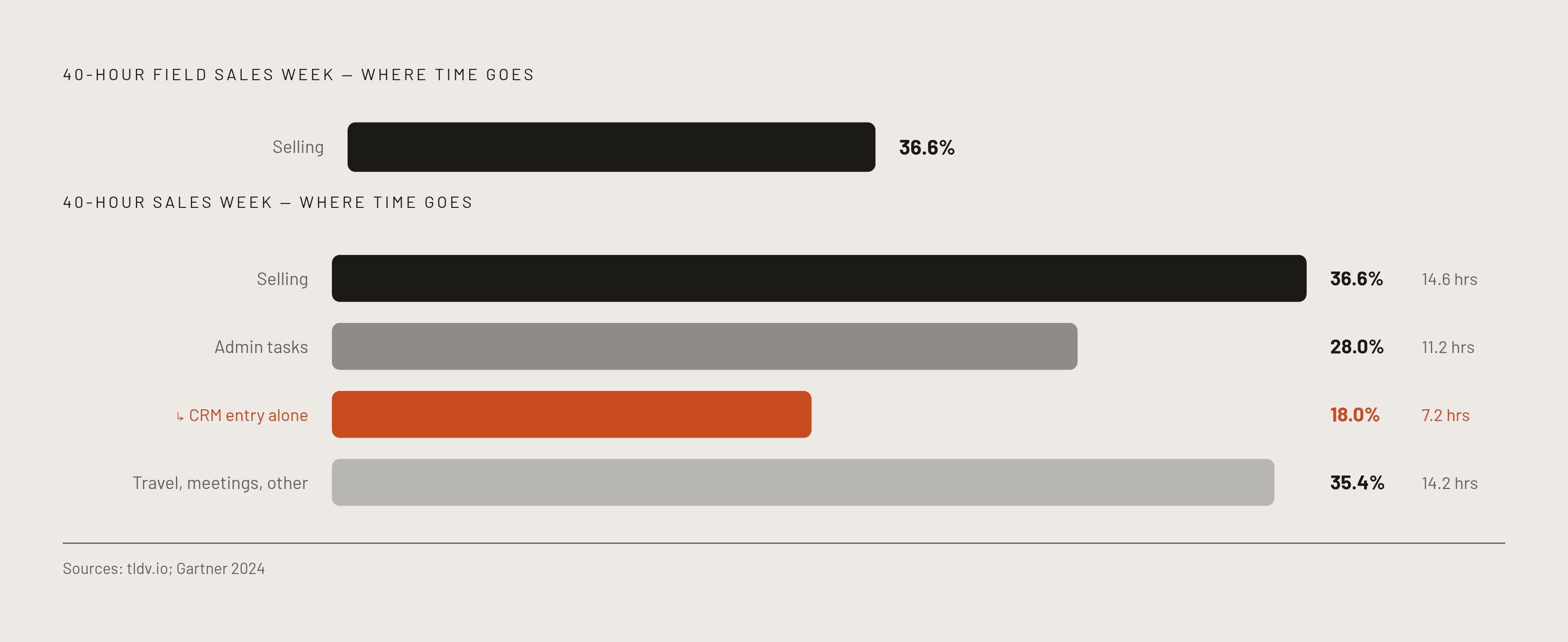
Field sales reps sell for a fraction of the hours they're paid to work, and the biggest thief is the paperwork. It's the paperwork. Research from tldv.io puts actual selling time at 36.6% of a rep's week, and Bain & Company's estimate runs even lower, closer to 25%. That gap between hours worked and hours spent selling is not a discipline problem. It's a design flaw in how field sales tools were built, and AI note-taking is the first credible fix for it.
Start with the number that should make every VP of Sales uncomfortable: the same tldv.io data shows roughly 18% of a rep's time goes to CRM entry alone. That's not a rounding error in a time-motion study. Salesforce's 2026 report, cited by the AI note-taking company Vibe, arrives at a strikingly similar conclusion from a different angle, finding reps spend only about 40% of their time actively selling. Two independent measurements, two different methodologies, and they land in the same neighborhood. That convergence should settle the debate: this is a real problem, not an anecdote.
Do the arithmetic on a standard 40-hour week. If a rep loses even 15 percentage points of selling time to administrative overhead, that's the equivalent of losing a full day, every week, to typing. Multiply that across a 50-person field team and the lost selling capacity starts to look like a headcount problem dressed up as a workflow inefficiency. No one budgeted for a phantom employee who does nothing but log call notes, yet that's effectively what most field orgs are running.
None of this reflects poorly on the reps. A rep who skips full CRM notes after a nine-stop day isn't lazy, they're triaging, and the tools gave them nothing better to do. The fix is a structural one. It's a structural one: change what capturing a sales conversation requires of the rep's time and attention, and the selling hours come back on their own.
Why the CRM data problem is worse than most sales leaders realize
The time lost to CRM entry undersells how bad the underlying data problem is. DestinationCRM data, cited by the sales intelligence firm Dymesty, found that 79% of opportunity data never makes it into the CRM at all. Not summarized poorly. Not entered late. Never entered.
Sit with that ratio for a second. If nearly four out of five data points from a field conversation vanish before they ever reach a system of record, then every forecast built on top of that CRM is built on the sliver that survived, not the conversation that actually happened. Pipeline reviews become an exercise in analyzing the small sliver of reality that got typed in, while the rest, the objections raised, the competitor mentioned by name, the budget concern that came up at minute 40, disappears with the rep's memory of the drive home.
Managers feel this most acutely in coaching. Without a record of what was actually said, coaching becomes reactive and secondhand, built on a rep's self-report of how a call went rather than what happened in it. That's a fundamentally weaker foundation than a transcript, and it's the reason so much field sales coaching amounts to generic advice instead of specific correction.
The damage compounds going forward, too. IBM's State of Salesforce 2025-2026 report, cited by a CRM company, found that 53% of organizations name poor data availability and quality as the leading barrier to adopting agentic AI. Bad CRM hygiene doesn't just hurt this quarter's forecast. It blocks the next generation of AI tools that sales orgs are counting on, because those tools need clean historical data to reason over, and most CRMs don't have it.
The same vendor-cited research, drawing on Salesforce's State of Sales report, puts a number on the recoverable time: manual CRM data entry costs sales teams roughly 5.5 hours per rep, per week, in 2026. That's the pool automation is competing to reclaim. A rep just left a site visit, they're back in the truck, the next appointment is in twenty minutes, and the CRM app wants a paragraph of notes typed on a six-inch screen while merging onto a highway. Under that condition, thorough note-taking is a task that was never realistically going to survive contact with the job. It's a task that was never realistically going to survive contact with the job.
That's the workflow gap the next generation of tools has to close, and it starts with recognizing that most of what's on the market wasn't built with that truck, or that driveway, in mind.
Why most AI note-taking tools were not built for field sales
Most AI note-taking tools operate on a single mechanism: they join a calendar link on a video platform, and they listen. That works well for inside sales and works well for anyone whose entire day happens on a screen. It does nothing for a field rep, because a field rep's real conversations happen in showrooms, on construction sites, across a client's conference table, or over dinner with an executive who will never generate a Zoom invite.
Phone calls made from a personal cell, trade show floor conversations, the kitchen-table pitch to a homeowner: none of it has a calendar link to join. A bot built to sit silently in a virtual meeting room has no room to sit in.
This is why the category splits cleanly into two tracks. Software-based meeting assistants are built for virtual calls and depend on a bot joining a scheduled meeting. Hardware wearables and mobile-first apps are built for in-person and phone capture, and they don't need a calendar event to know a conversation is happening. Most field sales teams end up needing both, or a platform architected to bridge the two, because no single track covers the full range of where a field rep actually talks to customers.
There's a legal wrinkle here that field orgs cannot treat as an afterthought. Eleven states require all-party consent to record a conversation, including California, Delaware, Florida, Illinois, Maryland, Massachusetts, Montana, Nevada, New Hampshire, Pennsylvania, and Washington, though the exact list can vary by source and should be verified before any deployment. The remaining 39 states and the nation's capital require only one-party consent under federal law. A rep who drives a regional territory can cross from a one-party state into an all-party state without noticing, and the recording rules change the moment they do.
That means any field deployment of AI note-taking needs a consent protocol built in before the rollout, not patched in after a complaint. This is a design requirement for the tool and the training that goes with it. It's a design requirement for the tool and the training that goes with it.
Hardware and mobile tools that capture what video bots cannot
The AI note-taking device market has moved past being a one-brand story. By 2026, several distinct hardware approaches compete for the same field-rep use case, each with a different tradeoff.
Plaud's NotePin S clips to a shirt collar or a blazer lapel, giving it a discreet form factor that solves a real social problem: pulling a phone out and setting it on the table in front of a C-level prospect changes the tone of a meeting. The device runs 20 hours on a charge, holds 64GB of storage (roughly 240 hours of recording), and supports 112 languages. Pricing runs $179 upfront plus a subscription, $6.99 a month for the basic tier or $16.99 for pro. Plaud's user base has been reported at more than 1.5 million as of April 2026. The device captures both phone calls and in-person audio, though summaries generate after the recording ends rather than live.
The Vibe Dot, released in mid-2026, runs $199 and records up to 30 hours continuously on 64GB of local storage. Its more interesting feature is Voice Activity Detection, which starts recording automatically within a configurable window of working hours, catching the pre-meeting small talk and post-meeting debrief that a manually-triggered recorder misses entirely. It carries a TPM 2.0 encryption chip with FIPS 140-3 hardware encryption, along with SOC 2 and HIPAA certifications, along with NDAA and FERPA compliance, which matters for field reps selling into regulated industries like healthcare or government contracting.
Rilla is an enterprise field coaching option at $4,000 or more per seat, per year. That price tag reflects a different ambition: it's built to address the coaching gap specific to field sales, not just to produce a transcript.
Every wearable recorder in this category shares the same structural limitation. Processing happens after the recording stops. A 60-minute meeting produces a transcript the rep waits for, not one they can act on between back-to-back appointments, and that gap pushes reps toward either waiting around for processing to finish or falling back on manual entry, which defeats the point of buying the hardware in the first place. Add to that limited or no CRM integration on most devices, personal knowledge bases that don't support team-wide collaboration, audio quality that degrades in noisy environments like a warehouse floor, and a subscription cost stacked on top of the hardware purchase.
Hardware solves capture. It doesn't solve CRM sync, and it doesn't solve coaching, at least not on its own. That's the gap software has to close.
Software-based AI note-takers: what field reps need to evaluate differently
Three variables separate a tool that actually helps a field rep sell from a tool that only records them, according to Plaud's category review: it captures objections and buying signals without manual tagging, it auto-populates the CRM with zero copy-paste, and it produces coaching insight a manager can act on. Everything else, transcription accuracy, summary formatting, is secondary to those three.
A tool with weak CRM sync doesn't just create friction for one rep; it feeds bad data into every AI initiative built downstream of that CRM, compounding the data quality problems that IBM's research identifies as the leading barrier to AI adoption.
Gong sits at the top of the enterprise tier, with pricing that reflects its full-platform ambition. It offers deep CRM automation with Salesforce and HubSpot, and its October 2025 release, Gong Orchestrate, introduced agentic AI that acts on deal signals rather than just surfacing them for a human to read. Gong Enable, launched in February 2026, unified coaching and training across the revenue stack. Gong was named a Leader in Gartner's inaugural Magic Quadrant for Revenue Action Orchestration in December 2025, ranking among the top performers across multiple use cases, and Paycor's customer case study with Gong reported a 141% increase in deal wins after adoption. Field teams face a limitation: Gong's model depends on a bot joining a scheduled call, which limits it for offline or phone-only field conversations.
Fireflies.ai starts its Pro tier at $10 per seat per month, billed annually, and covers CRM notes and automation into Salesforce and HubSpot. Its methodology support runs on keyword trackers rather than native scoring, and it has no documented bot-free recording mode.
EchoIQ, sold under the MaxIQ brand, connects individual calls to pipeline and forecast rather than treating each call as an isolated note. Its Revenue Intelligence add-on includes two-way CRM field updates, deal risk alerts, and forecasting support. Meeting Assistant plans start at $19 per seat, per month, billed annually, with a usage-based pricing option available.
Fathom holds the highest rating on G2 of any AI note-taker as of mid-2026, a 5.0 across more than 6,000 reviews, and it has the strongest free tier in the category: unlimited recording and transcription, plus five advanced AI summaries a month on the free plan (basic summaries remain available past that cap). It syncs to Salesforce, HubSpot, and Close, but it runs on a bot-joins-call model, which makes it a better fit for individual reps or small teams than for a full enterprise field org.
Avoma transcribes in more than 75 languages, and offers automatic BANT, MEDDPICC, and SPICED scorecards on its higher pricing tiers, with CRM updates flowing to Salesforce, HubSpot, and Zoho. It's built as a mid-market, full-meeting-workflow tool.
Coffee takes an agent-led approach: it joins Zoom, Teams, and Meet, generates summaries structured around BANT, MEDDIC, or SPICED, enriches contact records, and logs complete notes directly into Salesforce, HubSpot, or its own CRM. A desktop app for macOS, Windows, and Linux, launched in January 2026, gives it a documented bot-free recording option, and its CRM sync runs bi-directionally, writing insights back into the CRM rather than only pulling data forward. Coffee positions itself explicitly as a CRM agent rather than a transcription tool.
tl;dv offers free unlimited recordings and paid plans starting around $20 a month, with native integrations to HubSpot, Salesforce, and Pipedrive, a claimed transcription accuracy above 97%, and AI-generated summaries. It's a reasonable starting point for a team new to the category and not ready to commit to enterprise pricing.
HubSpot's 2025 report found that 84% of sales professionals say AI saves them time and streamlines their process, with 64% saving between one and five hours a week, and at least one practitioner cut post-call admin by 80%. Those figures are directional, pointing in a consistent direction rather than guaranteeing any specific rollout. For a field team specifically, the deciding factor isn't feature depth, it's capture model: a tool that only activates when a rep joins a scheduled video call sees a fraction of what a field rep's day actually contains. Mobile-first or bot-free capture is the whole point for this buyer. It's the whole point.
What AI does with conversation data beyond the transcript
Transcription and conversation intelligence are not the same thing, and the difference is where most of the value sits. Transcription converts speech to text. Research from ZoomInfo shows conversation intelligence analyzes that text to pull out deal risk, competitor mentions, objection patterns, and coaching opportunities, then ties those insights back to CRM records and revenue outcomes.
Research from The Quantum Leap Business describes four things modern platforms do at once by 2026: tag conversations against a defined sales methodology, whether that's MEDDPICC, Sandler, Command of the Message, or a custom playbook, score rep behavior against a rubric, surface deal-level risk from language patterns, and execute follow-up actions, drafting emails, updating CRM fields, scheduling next steps, without a human doing it manually.
That last part is the real shift happening in 2026: agentic coaching. Older tools flagged a missed discovery question and left the rep to fix it. Current tools draft the follow-up email, update the CRM field, and assign the next action themselves, with no human step in between.
For a field sales leader, the value isn't cleaner note formatting, it's visibility into conversations they were never physically present for. A manager can't ride along on every call a 30-person field team runs in a week. Conversation intelligence is the mechanism that gets them into the room anyway, after the fact, with a record instead of a rep's paraphrase.
Real-time, in-person guidance is the frontier the category is building toward next. The Quantum Leap Business's research names sub-400ms suggestion lag, support across more than 30 languages, and on-device redaction of personal information as standard expectations now built into enterprise deployments. Sentiment analysis that catches the moment empathy drops mid-conversation, and AI roleplay that lets a rep rehearse an objection before the next call, round out the coaching layer.
None of this replaces the basic economics from earlier in this piece, it just attacks them more directly. Gartner's 2024 Sales Productivity report, cited by Plaud, found reps spend roughly 28% of their week on administrative tasks, with CRM entry as the single largest piece of it. Conversation intelligence platforms go after that number by making the CRM update a byproduct of the conversation itself, not a chore that comes after.
How winning behaviors spread across a field team when conversation data is captured at scale
Once every rep's conversation is captured, a manager can finally see, with evidence instead of guesswork, what separates the top 10% of the team from everyone else. The specific questions they ask. The exact way they handle a pricing objection. The moment mid-call where they slow down instead of rushing to close. That pattern, once visible, becomes teachable, and teachable at a scale one manager's memory could never support.
Paycor's case study with Gong reported a 141% increase in deal wins after adopting conversation intelligence. What actually changed there is not the reps' skill overnight, but the visibility into what was actually happening on their calls, which is a very different mechanism than a training seminar or a new comp plan.
Broader productivity research backs the pattern. Data from leadresponse.co found AI users report being 47% more productive overall, saving an average of 12 hours a week by automating repetitive tasks like data entry, research, email drafting, and follow-up scheduling. That's roughly a day and a half of a standard workweek, recovered.
Coaching compounds when it's grounded in a rep's actual words instead of a manager's impression of how a call went or a rep's own self-report. A rep coached against their real conversation improves faster than one coached against secondhand summary, and at team scale, that gap appears as shorter ramp time for new hires and a higher floor for the whole roster, not just a higher ceiling for the stars.
None of this is really a features story. Systematizing what top performers do is closer to a philosophy: the captured conversation becomes the curriculum, the AI surfaces the pattern inside it, the manager delivers the lesson, and the rep applies it on the next call. But the whole loop depends on adoption holding up under pressure, and adoption depends on friction. A tool that requires a rep to remember to hit "record" before every meeting will get skipped the first time a day runs long, which is precisely why the field-specific, hands-free capture mechanisms covered earlier in this piece aren't a convenience feature. They're the reason the loop survives contact with an actual sales day.
What to look for when evaluating AI note-taking tools for a field team
Coffee's evaluation methodology lays out a set of criteria that separates tools that move pipeline from tools that just generate a transcript nobody reads.
CRM sync quality and data hygiene comes first, and it's not a checkbox question. A field team needs to know whether a tool writes structured fields into the CRM automatically or dumps an unstructured summary a rep still has to translate into pipeline data by hand, because the second version recreates the exact 79%-data-loss problem this piece opened with, just with a nicer-looking transcript attached.
Capture model matters just as much: does the tool require a scheduled video meeting with a bot invited to it, or can it run on a phone or a wearable without a calendar entry at all. For a field rep whose real conversations happen in a driveway or a showroom, this single question eliminates half the market before pricing even enters the conversation.
Consent and compliance handling has to be built into the product and the rollout plan together, given the split between the eleven all-party-consent states and the thirty-nine one-party states covered earlier. A tool with no clear consent workflow raises a liability question, not a minor gap to patch later.
Processing latency separates tools a rep can act on between appointments from tools that produce a transcript the rep has already forgotten the context for by the time it arrives. Coaching usability is the last major filter: does the output give a manager something specific enough to coach against, a moment, a phrase, a missed question, or does it hand back a generic summary that reads the same for every call regardless of how it actually went.
None of these criteria replace the basic math from the start of this piece. A field team loses selling hours to admin work because the tools built for inside sales, virtual meetings, and desk-bound workflows never matched how a field rep actually spends a day. The tools now exist to close that gap. Leadership's choice of a tool built for the driveway, not just the desk, separates the field teams that recover a full day of selling time a week from the ones still buried in CRM entry.