Conversation Scorecards for Field Sales Rep Development
Standardized conversation scoring replaces inconsistent coaching with aligned rep development.

Conversation scorecards give field sales teams a shared standard for rep development. Their value is not the number assigned to a conversation, but the behavioral framework behind it. When that framework is used for every captured conversation and in regular coaching, teams have a repeatable way to improve execution instead of leaving each manager to judge it their own way.
Why field sales teams keep producing inconsistent results despite consistent effort
A field sales team can work hard, talk with prospects, and still miss its targets. The absence of a shared definition of good execution often undermines that effort. One manager rewards a particular discovery approach, while another emphasizes a different way to handle objections or close. So reps on the same team are coached to do different things.
Those standards often stay in each manager’s head instead of being written as criteria that anyone can use. Reps must interpret what their manager means by a strong conversation, and leaders have no common basis for comparing development needs. The first step is to spell out those expectations. Only then can coaching reinforce the same behaviors across the team.
What a conversation scorecard actually is and how it differs from a dashboard or a spreadsheet
A dashboard aggregates team outcomes, including pipeline value, win rate, and quota attainment. It shows what happened, but does not explain which conversational behaviors need to change. A conversation scorecard is a structured evaluation system that applies consistent, observable criteria to individual sales conversations. It is a rep-level development tool.
The distinction lies in what gets evaluated, whether the information appears in software or a spreadsheet. An activity log records that a conversation happened, while a scorecard evaluates discovery depth, objection handling, value proposition delivery, next-step clarity, and talk ratio. These are actions the rep controls during and around the conversation. A useful criterion describes something verifiable, such as “rep confirmed the buying process” or “rep agreed on a specific next step”. That specificity turns a broad concern about performance into a defined coaching need.
The four behavioral dimensions a field sales scorecard needs to cover
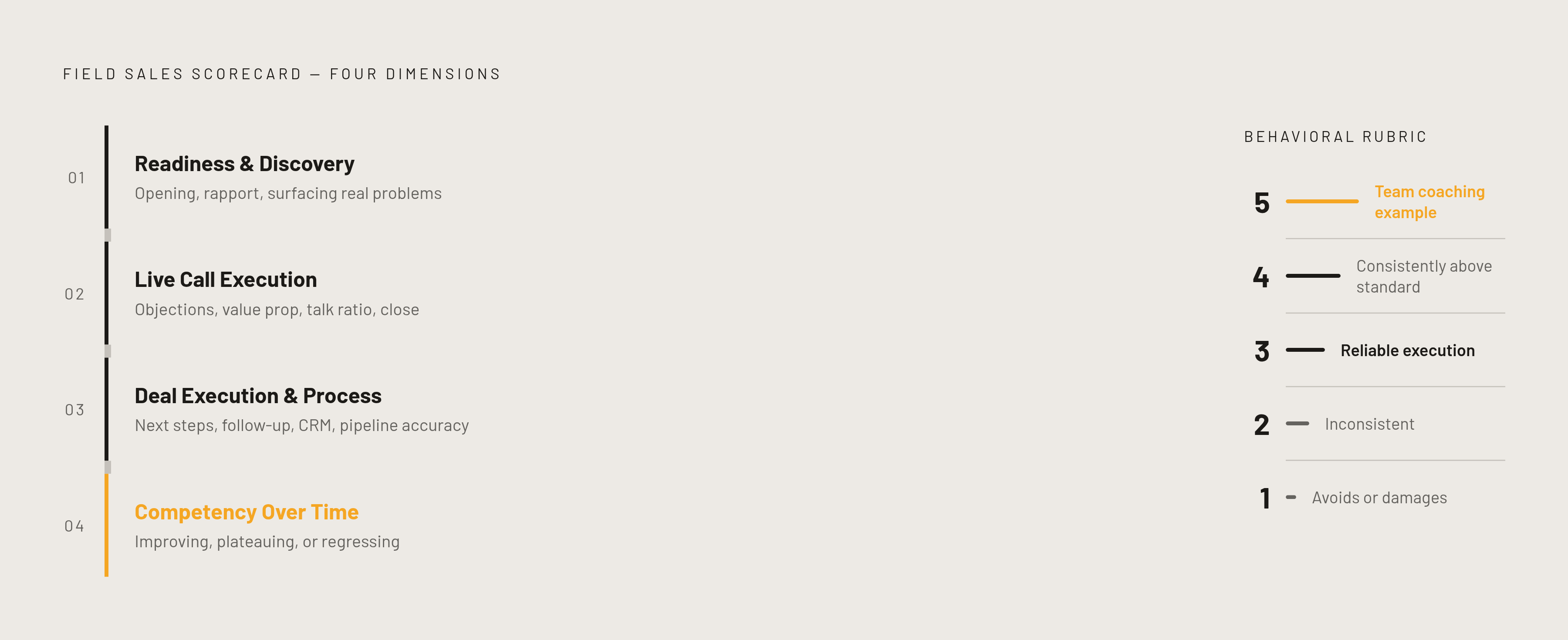
Readiness and discovery quality capture how the rep opens, establishes rapport, and asks questions that surface real business problems. Discovery depth gives managers an early sign that a deal is moving forward before an outcome metric shows it. Live call execution covers objection handling, value proposition delivery tied to stated pain, talk ratio, pacing and energy, and closing directness. This dimension shows where the rep moves the prospect forward or allows the conversation to stall.
Deal execution and process adherence cover next-step clarity, follow-up timing, CRM hygiene, and pipeline stage accuracy. They reveal whether the rep follows the playbook across opportunities, including when a manager is absent. Competency development over time tracks whether performance across those dimensions is improving, plateauing, or regressing. That trend distinguishes an isolated weak conversation from a persistent skill gap.
For field reps on first appointments, give more weight to discovery and objection handling, while for reps who manage longer cycles, give more weight to next-step clarity and deal execution. Each dimension should use a 1–5 behavioral rubric. A “3” represents reliable, consistent execution, while a “5” represents a call the whole team can learn from.
How the subjectivity problem compounds in field sales specifically
On a ride-along, the manager is beside the rep for only a small share of the conversations the rep has. The rest take place in homes, job sites, and offices the manager will never enter. Without a recorded, structured account, coaching depends on the rep’s memory, filtered through optimism, selective recall, or an explanation of why a deal stalled.
A manager who hears three calls cannot tell whether a discovery gap in one of them recurs across the other conversations that week. A scorecard applied to all captured conversations makes that pattern visible. Timing adds another constraint because valuable coaching opportunities occur between appointments, when the manager is unavailable. If the manager has to be there to give feedback, those chances pass without support.
How AI-powered scoring shifts conversation coverage from a sample to a standard
Manual review still requires a manager to listen to a recording, apply the criteria, write justifications, and deliver feedback. That workload limits evaluation even when the framework is well designed. AI-powered scoring makes broader coverage practical by transcribing every captured conversation, scoring it against predefined criteria, and returning criterion-level feedback tied to specific transcript moments.
One rubric can then be used across conversations, in place of each manager’s own standards for a small sample. Every rep is then judged on the same basis, whoever their manager is. Coverage, however, extends only to conversations the system captures. Field teams therefore need in-person capture on a mobile device.
AI replaces the scoring workload. Its assessments are raw material for coaching. The manager interprets the evidence, identifies what matters most, and designs the development response.
What to look for in field-specific scorecard tooling
Mobile-first, in-person capture is the baseline requirement because field conversations do not depend on video calls. Beyond capture, evaluate what percentage of conversations a tool actually scores and how it handles recordings of different lengths and completeness. Ask vendors to show how the workflow works on a typical field recording before comparing feature lists. Automated grading, manager review, and live guidance are separate capabilities, and one does not establish the others.
Coaching timing also needs a precise distinction. Real-time in-call prompts guide the rep while the conversation can still change, and post-call conversation intelligence takes a deeper look afterward. Roleplay and pre-call tools support practice before the next conversation. Field teams get the most from post-call scoring with asynchronous delivery because reps can use the feedback between appointments. Feedback is easier to use when each criterion points to the transcript, setup takes little work, and reps can see their own progress.
Product scope and licensing require equal attention. Gong has conversation intelligence and basic coaching dashboards in its Foundation plan, while Forecast, Engage, and Gong Enable are separate add-on modules. Outreach Kaia documents Coach Cards, reporting, playlists, and live Content Cards, so verify whether the proposed workflow supplies the required automated grading rubric and record manual steps. Dialpad documents AI Scorecards for Sell and Support, including AI Questions, with an additional fee. Revenue.io makes AI Generative Scorecards accessible through Salesforce conversation records, with results dependent on call eligibility, processing, and enabled settings. Allego 9, unveiled May 2026 at Sales Success Summit and generally available June 2026, puts AI directly into the work of driving revenue across workflows. These capabilities are not interchangeable, so verify the exact scorecard workflow rather than inferring it from a broad product description.
How scorecards change the manager's coaching conversation from diagnosis to development
Shared evidence changes where coaching begins. Instead of reconstructing a stalled deal from memory, the manager and rep can examine a weak discovery rating and the transcript excerpt supporting it. The discussion can move directly to the behavioral gap. A rep who books meetings but does not advance them has a specific development need to address before it becomes a missed number.
This is where AI-generated assessments become useful raw material rather than a substitute for coaching. The manager chooses which skill to develop first, interprets the context, and delivers difficult feedback through a relationship that can sustain trust. Sending an AI summary marked “see areas for improvement” does not perform that work. The assessment identifies evidence, while the manager turns it into a development priority.
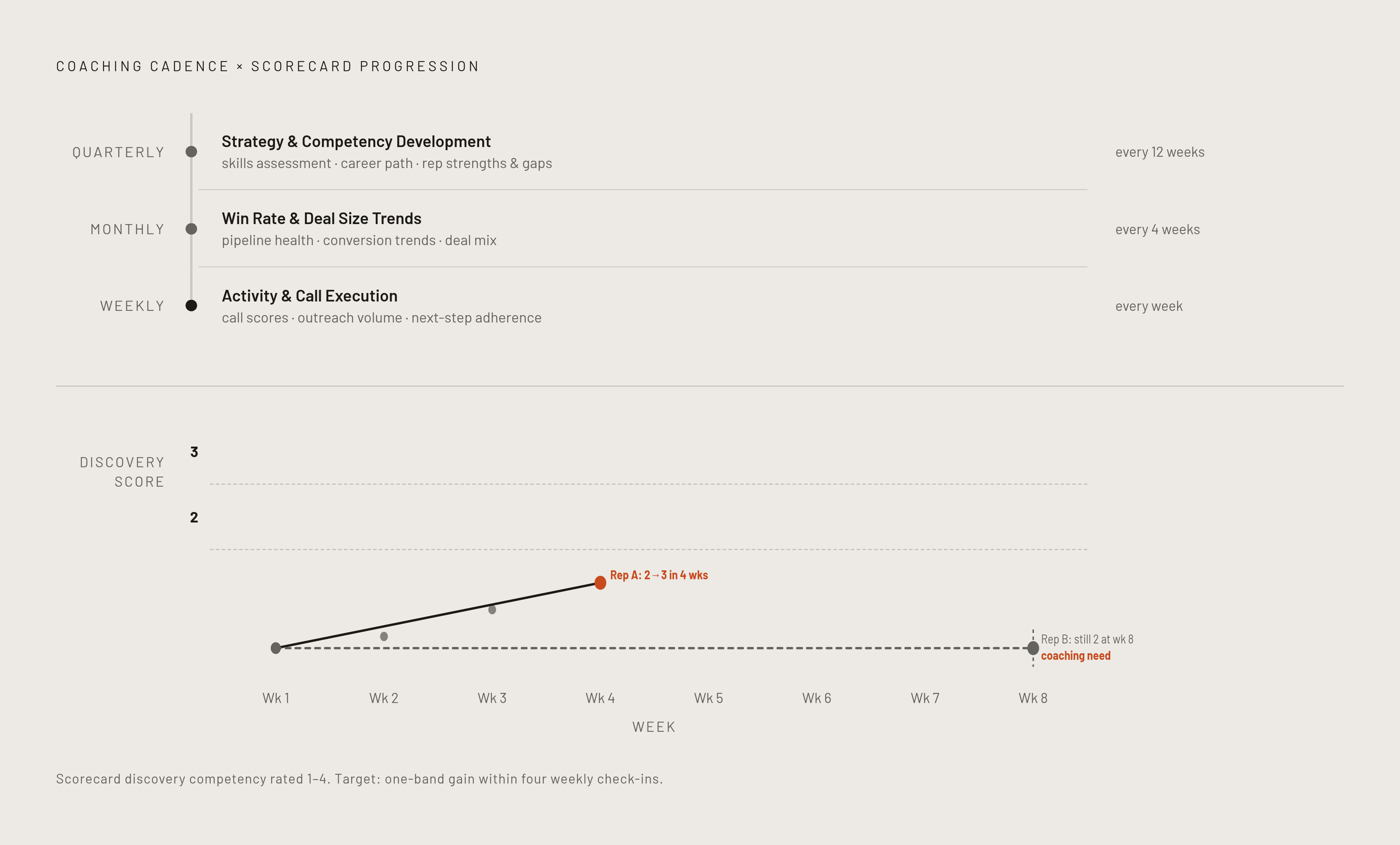
A regular cadence gives that work continuity. Weekly check-ins cover activity and call execution, monthly reviews look at trends in win rate and deal size, and quarterly sessions focus on strategy and competency development. Reps who can see their own dimensional scores can also self-correct between conversations. The manager’s time can then focus on what a stronger discovery or objection-handling sequence would look like in the rep’s next conversation.
How scorecards accelerate new rep ramp and spread winning behaviors across the team
For a new rep, an explicit rubric removes the need to decode a manager’s private expectations. A 3 on each dimension is the target for a fully ramped rep, while 2s are expected early and tracked for improvement. With feedback on every recorded conversation, reps can see their progress before the next ride-along. The learning target remains shared across managers and markets.
The same framework turns strong performance into material the rest of the team can study. Conversations scoring 4s and 5s become a library of examples, including a discovery sequence that uncovers a real business problem or an objection handled under field conditions. A new rep can hear what the rubric describes. Top performance becomes teachable through concrete conversational evidence.
This extends the scorecard beyond correcting struggling reps. Winning behaviors can be documented in the rubric and taught across the team. As reps see their own progress, accountability depends less on managers hovering over individual activities. The team gains both a common target and examples of how to reach it.
Three design choices that determine whether a scorecard develops reps or just surveils them
A badly designed scorecard becomes a tool for watching reps. The first design choice is therefore to keep criteria behavioral and observable. “rep was enthusiastic” expresses an opinion, while “rep confirmed the prospect's specific buying process” describes something a reviewer can verify. Supporting conversation evidence makes the basis of the assessment visible to the rep.
The second choice is to separate scorecard scores completely from compensation and performance-management decisions. When scores affect pay or formal judgments, reps have reason to prioritize optimizing for the score over learning. Disputes about the assessment displace coaching discussions about the gap.
The third choice is to give reps access to their criterion-level scores and transcript references before the manager reviews them. Seeing that evidence lets the rep make changes on their own and get ready to talk about how to improve based on that evidence. The framework also needs an honest limit because observable criteria cannot replace judgment about deal strategy, relationship depth, or context absent from a transcript. A scorecard that makes its evidence, purpose, and limits clear earns rep trust.
Implementing a conversation scorecard: what to build first and how to make it stick
Start with the three to five behaviors that most reliably separate winning conversations from losing ones on the team. Take them from top performers’ best conversations. First, establish what strong discovery actually looks like in the team’s market, with its typical buyer. That keeps the first rubric small and relevant.
Then write observable criteria and anchor each to a 1–5 rubric. Describe execution at 1 as avoids or damages, at 3 as reliable, consistent execution, and at 5 as a coaching example for the whole team. Pilot the rubric with voluntary participation on a single team, then fix ambiguous criteria, disputed anchors, and adoption friction before broader rollout.
Once the rubric is usable, connect it to mobile-first capture of real in-person conversations. Otherwise, the system returns to manual evaluation of a small sample or scoring of self-reported summaries. Before launch, set times for weekly criterion-level check-ins, monthly development reviews, and quarterly competency sessions.
Track improvement by dimension rather than treating absolute scores as the destination. A rep moving from a 2 to a 3 on discovery over four weeks shows the intended development arc, while a rep still at a 2 after eight weeks has a visible coaching need. As the system matures, connect that behavioral progress to business performance. The outcome metrics are win rate, deal velocity, pipeline hygiene, forecast accuracy, rep ramp time, and coaching impact.